
Beyond the Headlines: One Ukrainian's Story of Living Through War

I have intentionally distorted this photograph to protect Anna's identity. But the distortion also serves another purpose. It reflects what life has become for her—and for millions of Ukrainians living under the shadow of this war. Their world has grown increasingly blurred, its colors slowly fading, even as their suffering slips from the attention of much of the world.
Ever since Russia's full-scale invasion of Ukraine began, I have wanted to document it. Circumstances have kept me from going.
Not a day passes that I don't think about the people living there. What troubles me almost as much as the war itself is how little sustained attention is given to the ordinary Ukrainians enduring it. Headlines report military advances and political maneuvering, but they rarely linger on the quiet cost borne by those simply trying to survive.
My dear friend, Anna, lives in Kyiv. We stay in touch through social media—the only reliable way we have to communicate. During the first year of the invasion, I also met periodically, through virtual technology, with a small group of Ukrainian women who were teachers. More than once, as we talked, our conversation was interrupted by the unmistakable sound of explosions. It was surreal to be sitting safely at home while they calmly continued speaking from a city under attack.
Every so often, Anna sends me a photograph of herself. With each one I notice the same thing: a little more weight lost, a little more light gone from her eyes. The youthful spirit I once knew has gradually been replaced by exhaustion. There is a weariness in her expression that no one should have to carry.
For now, my own injuries make the journey impossible. But when I have fully recovered, if the war continues, I intend to go on my own dime. I don't want to photograph battlefields nearly as much as I want to witness the lives of those caught in the middle of them—the families, the teachers, the elderly, the children, the people whose stories are too often overshadowed by maps and military briefings.
Imagine living in a place where you never know whether you will wake the next morning, or whether you will survive the coming day. Drone strikes arrive without warning. A building standing one moment can be reduced to rubble the next. Air-raid sirens become part of the rhythm of everyday life.
I remember talking with Anna during one of Kyiv's bitter winters after Russian attacks severely damaged Ukraine's electrical infrastructure. Entire neighborhoods were left without heat while temperatures remained well below freezing. It is difficult to comprehend that reality from the comfort of a warm room.
In a recent message, Anna told me that many Ukrainians are now fearful of another winter without reliable heat. She worries that limitations on Ukraine's air-defense capabilities could leave critical infrastructure increasingly vulnerable to future attacks. Whether one follows the war through politics or military analysis, it is easy to lose sight of what those decisions ultimately mean: families wondering whether they will have electricity, warmth, or even a home when winter arrives.
That is the Ukraine I hope to document—not the machinery of war, but the resilience of ordinary people determined to live despite it.
For millions of Ukrainians, however, it was simply another day of enduring a war they never chose.
I have decided to present the most recent email I received from Anna, so that you can read from her own words.
________________________________________________________________________________
Life in Kyiv During the War
by Anna Tkachenko
The following letter was written by my friend Anna, who has lived in Kyiv throughout Russia's full-scale invasion. I have reproduced it with her permission, exactly as she wrote it.
“Every person carries within them an entire world — a world of memories, dreams, losses, hopes, and encounters. Some moments of life fade from memory like footprints in the sand touched by the wind, while others remain forever in our hearts and souls.
We all have our own unique life story. It contains joy and sorrow, triumphs and setbacks, moments when we wanted to laugh with happiness, and days when it seemed that the whole world had become too heavy to bear. Yet it is precisely these moments that make up the story of a human life.
I was born in the beautiful city of Kyiv, a city with a rich history. It is a place that has always inspired me. My childhood, like much of my life, was not easy. I remember the days when we had almost no food at home and how my sister and I would rejoice over pasta with cheese as if it were the finest meal in the world.
Life in Ukraine in the early 1990s, when the country gained its independence in 1991, was difficult primarily because of a deep economic and social crisis. It was a challenging time for many people. Yet it was also a period of great hope. For the first time in many decades, Ukraine became an independent nation, gaining the opportunity to determine its own future, develop the Ukrainian language and culture, and build its own state institutions.
My childhood took place during difficult times. Yet the greatest hardships were not only about a lack of money or the uncertainty of the future. My father was a cruel man, and because of that, our home did not always offer warmth or a sense of safety. Some memories still hurt, even though many years have passed.
However, those trials taught me to be strong, to empathize with the pain of others, and to value people who bring kindness into the world. Even now, because I am unable to live separately, I have to remain under the same roof as the person who destroyed my life and my dreams—the person who made my mother cry every day. That is deeply painful.
Sadly, many women go through the same kind of hell.
My father started a family to be like everyone else, but he never truly cared about his wife or his children. He lived only for himself.
When my younger sister was born, he bought neither food nor clothes, nothing at all. I had been studying to become an interior designer, but I had to give up my dream in order to provide food and clothing for my mother and little sister. Unfortunately, at that time there was no opportunity to both study and work at that university. Students could only begin working alongside their studies after two years.
It was a difficult period. My mother had broken her leg and was unable to work, and my younger sister was still very small. I could not wait that long, so I left university and went to work.
I hardly had any days off. I worked fourteen hours a day. Sometimes I felt as though I could not endure it any longer and was ready to give up, but I knew I did not have that choice. I was responsible for my mother and my little sister, and they depended on me.
I remember that time... When I was working, I never bought anything for myself and barely had enough to eat. Later, my boots tore apart. They were autumn boots, but winter had already arrived, and I kept wearing them in the freezing cold with a hole in the sole. My boots were always wet and cold. One day, I became seriously ill and almost died.
There was so much in my life—so much pain and disappointment. Yet even now, I still believe that one day everything may change.
Every person should live with hope in their heart and, even in the darkest days of life, keep searching for the light.
My childhood was not easy either. I remember working to earn money for my school notebooks and uniform. I simply knew that life was difficult for my mother, and I wanted to help her in any way I could.
At that time, my mother paid for my English lessons, which were very expensive. My mother has always been my light and my hope. She taught me that no matter what happens, we should keep smiling and keep dreaming.
Whenever I was given a little money for food at school, I never spent it on myself. Instead, I gave it to homeless people and children. I did this because I believed that, at the very least, I had a bed to sleep in and a home to return to, while many of them had nothing—not even enough food to eat.
There is something truly beautiful about seeing happiness in another person's eyes. Sometimes the smallest acts of kindness, or a kind word spoken from the heart, can give someone hope and help them carry on.
If someone had told me a few years ago that one day I would be writing these words, I would not have believed them.
I would not have believed that ordinary things could become priceless. That silence could feel like a gift. That a simple message saying, “I’m home,” could bring such relief. That a person could live between fear and hope for so long and still find the strength to smile.
I remember mornings without air-raid alarms. I remember a time when the word “war” seemed like something distant, something that belonged only in the pages of history textbooks. I remember dreams that were easy to build, as if the future were something guaranteed.
Then the war came. Nearly five years have passed since the beginning of this bloody war.
It changed more than just the country. It changed us. It taught us to count our days differently, to value simple things, and to find courage where we had never thought to look for it before. It showed us how fragile life can be and how strong the human heart can become.
My life, like the lives of millions of Ukrainians, has been divided into two parts. There was a “before” — filled with ordinary worries, plans, dreams, and hopes. And then came the “after” — when every day became a reminder of how fragile the world we once believed to be unchanging truly is.
War takes away so much. It steals peace, a sense of safety, and confidence in tomorrow. But it also reveals things that people often never realize they possess: the strength of their own hearts, the value of human kindness, and the ability to find light even in the midst of darkness.
Every new day is a gift, and every moment of life is priceless. When you live in a country at war, you do not know whether tomorrow will come for you. It is like a roulette wheel — you either survive or you die. It is a lottery of life and death.
At first, you do not want to accept that life can end at any moment. You resist the thought and try to hold on to the belief that there will always be another tomorrow. But with time, you simply learn to accept it and understand that it has become a part of this harsh reality.
The war changed everything.
It taught us to live from one air raid alert to the next, from one news update to another. It taught us to cherish every message from our loved ones, every phone call, and every morning when everyone was still alive. It brought a pain that is difficult to put into words, yet at the same time it revealed the incredible strength of the human spirit.
I have seen fear. I have seen tears. I have seen the exhaustion in the eyes of people who continued to live despite everything. But I have also seen courage, kindness, and resilience. I have seen people helping strangers, supporting one another, and finding the strength to rise again after the hardest blows.
I pray that one day we will wake up under peaceful skies. This is my wish for everyone in this world who is living through the horrors of war. “
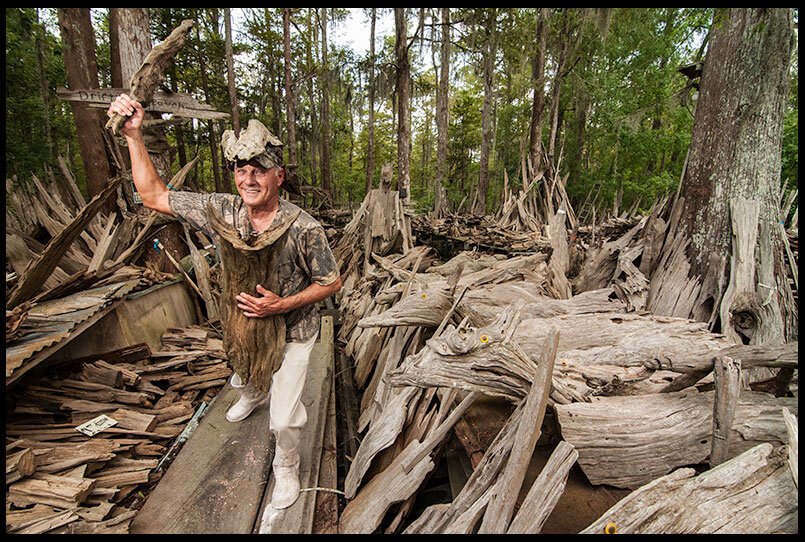
The King of Driftwood Paradise
Mr. Adam Morales owned, and operated the Adam's Cypress Swamp Driftwood Family Museum, in Pierre Port, Louisianna. Upon his death I felt moved to write a post about this joyous man, and his driftwood paradise.
There are people you photograph, and then there are people who quietly become part of the way you see the world. Mr. Adam Morales was one of those rare people.
As you read through this article, you may find yourself wondering why I refer to him so formally as Mr. Adam Morales—over and over again. The answer is simple: it is the way I always referred to him. At first—before we became friends—it was out of respect, but then—the more I got to know him, the more I realized that the name was more of a very deserving title—as if addressing royalty. To me, Mr. Adam Morales was royalty - he was Swamp Royalty. He was a breed of Cajun that has all but died out.
I rode with my dear friend, Gene Seneca, on the day that I was to meet Mr. Adam Morales at his home in Pierre Part, Louisiana. His modest home sat at the very edge of the swamp, where the dry ground surrendered to cypress knees and dark water. Scattered around the yard were hundreds of driftwood sculptures—as though the swamp itself had decided to populate the property with its own strange creations.
His home was also home to the Cypress Swamp Driftwood Family Museum, where every sculpture told a story about the swamp and the man who knew it so well.

At first glance, Mr. Adam Morales seemed wonderfully eccentric. That much was obvious from the sculptures that surrounded his home. But beneath that playful spirit was an exceptionally grounded man. That became evident only after spending time on his porch listening to stories of a lifetime spent in the swamps.

Although Adam appeared on Swamp People, and visitors came from around the country—including actress Eva Marie Saint and members of SEAL Team Six—none of it changed him. Fame rested lightly on his shoulders. He remained exactly the man I first met on that front porch beside the swamp.
Mr. Adam Morales was a kid at heart. It was evident in each of our conversations, and it was blatantly apparent in the sculptures he created. In his back yard, which was actually the swamp, he had bins piled high with pieces of driftwood. He called them his "body parts", as the driftwood pieces resembled arms, legs, fingers, etc. - and each were segregated to their own bin. It was from these pieces that he would build his sculptures.
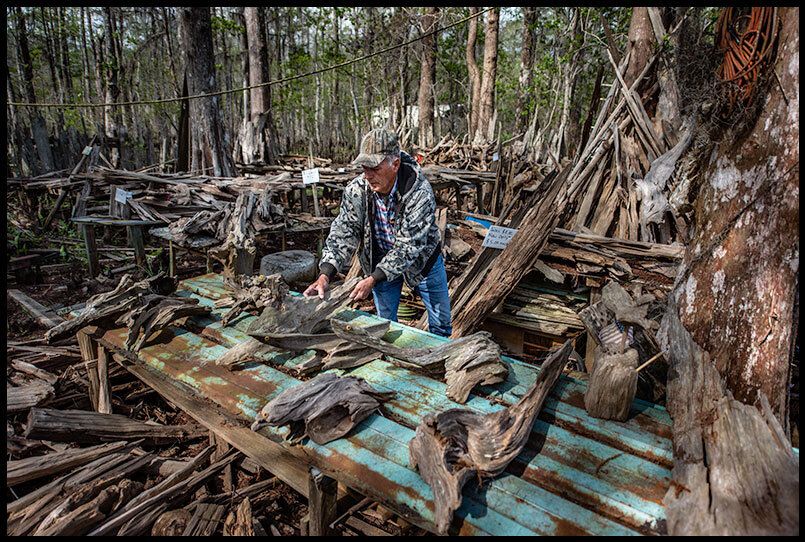
Every time we wandered through his collection of driftwood, Adam would suddenly stop, reach into a pile, and pull out a weathered piece of wood. I would see only an oddly shaped piece of wood. Adam would see a tiger waiting to be discovered. Then, as he turned it in his hands, suddenly I saw the tiger too. He had a way of teaching you to see it too.
In the latter years, Mr. Adam Morales began making oversized lawn chairs out of driftwood. I always wanted to buy a couple, but I never was able to transport them home - they were far too large.

For many years, Mr. Adam Morales made his living harvesting Spanish moss from the swamps. Standing in a small motorized boat, he would use a long pole to pull the moss from the cypress trees before selling it to florists and plant nurseries throughout the region. Then, almost overnight, synthetic moss entered the marketplace, and a way of life that had sustained him for decades simply disappeared.
It was dangerous work. More often than not, venomous snakes were hidden among the moss. When the moss dropped into the boat, the snakes often came with it. Adam never spoke of it as though it were extraordinary. To him, it was simply another day in the swamp.
I am a firm believer that, as we make our way through life - along the path of this great journey, we encounter experiences, and people that, in my way of thinking, become ingredients in the cauldron of soup that is our life's journey. The deeper and more genuine those encounters become, the richer the soup becomes. Mr. Adam Morales became one of the richest ingredients in mine.
Several days ago, word reached me that Mr. Adam Morales had died. With his passing, I couldn't help but feel that a little of old Louisiana had gone with him.

Mr. Adam Morales sitting in his ‘backyard’.
I know that each timeI return to south Louisiana, I will feel the longing to visit with him - and a sadness will become present in my heart. But I am forever grateful to have known Mr. Adam Morales—The King of Driftwood Paradise.
_David
Learning to Wait: Photographing the Navajo on Their Time
“Dine’” which is Navajo for “The People” seemed appropriate for the working title of my newest book project, on the Navajo People. This post talks about a Navajo family to turned to ranching in 1978. But more specifically, they raise bulls for the rodeo. In recent years Freddie has begun turning the business over to his two daughters.
I came to northern Arizona to document the Navajo—their history, their traditions, and their way of life. As with nearly every project I have undertaken involving Indigenous cultures, progress comes slowly. Even when relationships have already been established, trust moves at its own pace. This time is no exception.
I arrived with the expectation that I would begin telling the story of an 83-year-old Navajo woman who still tends her sheep every day and lives much as she has for decades: without electricity or running water. Heat comes from a wood stove, but even the firewood must be gathered from the surrounding hills. It is a life that has largely disappeared elsewhere, yet continues here.
As I neared my destination, however, I received word that her daughter—who would serve as my translator—would not be available. Since the woman speaks only Navajo, her story would have to wait.
Fortunately, another opportunity presented itself. I was invited to photograph a local ranching family and told to arrive at two o'clock the following afternoon. Just before leaving, I received another phone call. The youngest daughter was preparing to load three rodeo bulls for transport.
I arrived just in time to witness the loading. While it wasn't an especially dramatic photographic moment, it was fascinating to observe and, more importantly, it opened the possibility of another story within this growing project.

Then, almost immediately after I arrived, plans changed again.
The horses had escaped from the corral.
Finding them and bringing them home became everyone's priority.
While the search continued across the open plains, I spent time talking with the youngest daughter about her role in the family business, one her father had started in 1976. I also made a handful of photographs as the bulls were loaded into the trailer.
Not long afterward, the horses appeared in the distance.
When I saw Freddie walking across the broad Arizona landscape, leading the horses back toward the corral, I knew I was witnessing the photograph I had been hoping for. I started walking toward him, making photographs as he crossed the open country.

Once the horses were safely returned, it seemed the perfect time to sit down with Freddie for an interview.
It wasn't to be.
Another unexpected complication arose, and our conversation would have to wait. Instead, we stood outside together for several minutes, talking informally beneath the Arizona sky. Freddie spoke about ranching, raising rodeo bulls, and his plans to continue doing so even in partial retirement. Before we parted, we made tentative plans to meet again early next week—if he would be heading out to the ranch where he keeps the bulls.
It means extending my stay by several days.
If it happens, it will be time well spent.
This is their world that I have entered—not my world that they have stepped into. Those are two very different realities. Their priorities are not my schedule. Their rhythms are not my deadlines. Forgetting that would not only be insensitive; it would be arrogant.
Good documentary photography requires patience. Great documentary photography requires humility.
I believe in this story. More importantly, I believe in these people.
The Navajo have a story worth telling—not only for themselves, but for those of us on the outside who have much to learn by listening.
— David
In Search of Ann Reeves Jarvis: The Woman Who Believed Compassion Could Heal a Divided Nation
On the outskirts of Grafton, West Virginia, at 284 Pearl Felton Lane, sits an unassuming white frame house that has found its place in history as the house of Ann Reeves Jarvis, and the birthplace of Anna Jarvis - the founder, and creator of Mother’s Day. This tiny house is now a museum dedicated to Anna Jarvis, and the entire Jarvis family. But the museum, the house, and the land surrounding it, is steeped in Civil War history, early Civil Rights, the Underground Railroad, and a history of acceptance, and human rights.
February 8, 2019
Most people know Mother’s Day as a celebration of flowers, cards, and family. Few know that its roots began in a small West Virginia farmhouse with a woman who believed compassion should extend beyond battle lines, political divisions, and social boundaries.
On the outskirts of Grafton, West Virginia, at 284 Pearl Felton Lane, sits an unassuming white frame house that quietly holds one of America’s most remarkable stories. This was the home of Ann Reeves Jarvis—the woman whose life and work inspired her daughter, Anna Jarvis, to create Mother’s Day.
Today, the house is a museum dedicated to the Jarvis family. But the story contained within these walls reaches far beyond the creation of a holiday. It is a story of the Civil War, women’s leadership, early public health, the Underground Railroad, and a lifelong commitment to compassion and human dignity.
Ann Reeves Jarvis was an activist long before Mother’s Day existed. In 1858, while pregnant with her sixth child, she created what became known as the Mother’s Day Work Clubs. These grassroots organizations were formed to improve health and sanitary conditions throughout Taylor County, West Virginia, at a time when disease was one of the leading causes of infant mortality.
The clubs provided education and assistance to families, raised money to purchase medicine, and hired women to help expectant mothers experiencing health problems. Their mission was simple: to reduce suffering and improve the lives of those around them.
When the Civil War began, Ann Reeves Jarvis found herself living in a divided nation. Although she lived in Union territory, she refused to take sides in the conflict. Instead, she urged the Mother’s Day Work Clubs to remain neutral and continue serving those in need—regardless of which uniform they wore.
The Jarvis home stood on land that had been part of one of the largest Union encampments in West Virginia during the war. Union officers used the house for strategic planning, yet within those same walls Ann maintained her belief that compassion should not be limited by political allegiance.
When the Methodist Church considered dividing into northern and southern branches, Ann—a deeply committed Methodist—refused to support the separation. She believed faith and humanity should transcend political divisions.
As the war continued, the mission of the Mother’s Day Work Clubs evolved. Under Ann’s leadership, the clubs provided food, clothing, and assistance to soldiers from both sides of the conflict.
Near the end of the war, the Jarvis family moved several miles away to Grafton, West Virginia. There, Ann continued her work within the Methodist Church and oversaw the construction of Andrews Methodist Episcopal Church, where she taught Sunday School and became known as a respected public speaker.
According to the recollections of her daughter, Anna Jarvis, it was during a Sunday School lesson in 1876 that Ann Reeves Jarvis prayed for someone to create a day honoring mothers.
After her mother’s death, Anna carried that vision forward. In May 1907, she organized a private memorial service honoring her mother. A year later, in 1908, she organized the first official observance of Mother’s Day at Andrews Methodist Episcopal Church in Grafton.
After years of advocacy, Anna Jarvis succeeded in having Mother’s Day recognized as a national holiday. In 1914, President Woodrow Wilson signed a congressional resolution declaring the second Sunday in May as Mother’s Day and called upon Americans to honor the day by displaying the American flag.
Today, Andrews Methodist Episcopal Church still stands along Main Street in Grafton. It is now recognized as the official Mother’s Day Shrine.
The Anna Reeves Jarvis House offers another window into this remarkable family’s history. A guided tour begins in the kitchen, where beneath a large rope rug is a small door in the floor. According to the museum’s interpretation, this hidden crawlspace was used during the era of slavery as a place of refuge for those seeking freedom through the Underground Railroad.

A crawl Space, hidden beneath the rope rug that covers a large portion of the kitchen floor, in the Anna Reaves Jarvis house.
Throughout the house, artifacts and documents tell the story of the Jarvis family and the world they inhabited. Relics from the Civil War reveal the challenges faced by families living through one of the most divided periods in American history.

Photographs of Union soldiers occupy a section of tis original desk in the Ann Reeves Jarvis house. Also ration tickets, and a newspaper headline adorn the desk.
But perhaps the most unexpected and moving room is found on the second floor.
There, a collection of dolls fills a small room.
These dolls were not owned by the Jarvis family, but each one carries a story. Over the years, curator Olive Ricketts began receiving dolls from people around the world. Some arrived in person. Others came through the mail with handwritten notes attached.
Many were donated after their original owners had passed away, given to the Jarvis House so they would have a meaningful place to continue their lives.
Each doll represents a mother.
Together, they represent the continuing legacy of Ann Reeves Jarvis and Anna Jarvis—the belief that mothers, families, and human connections deserve to be remembered and honored.
A small piece of paper attached to one quilt acknowledges the person who donated it.
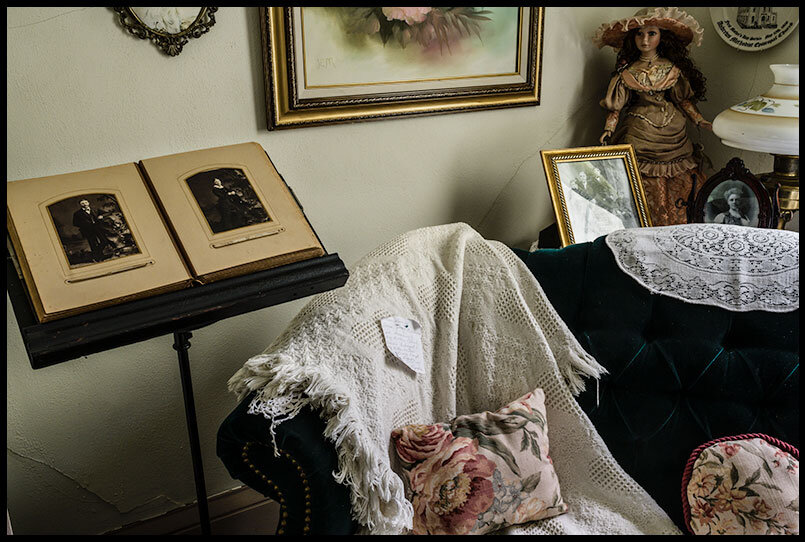
A piece of paper, attached to the quilt, gives an acknowledgement to the person who donated it.
It is a simple gesture, but perhaps that is what makes it so meaningful.
Behind every object is a person.
Behind every person is a story.
And that, ultimately, is the true legacy of Mother’s Day.
The Names We Give Our Hopes
This morning, as I drove from Pittsburgh back to Grafton, West Virginia, I decided to get off the Interstate and explore the town of “Prosperity.” For decades the name has intrigued me - like so many other names of towns across America, with names that make a statement …
August 4, 2019
For decades I have been fascinated by the names of small towns scattered across America—places whose names seem less like locations and more like aspirations.
This morning, as I drove from Pittsburgh back to Grafton, West Virginia, I left the Interstate in search of one of them: Prosperity. Like so many towns across America, its name seemed less a description than a declaration of hope by those who first settled there.
While searching for Prosperity, I first came upon the town of Amity.
Amity—a word meaning friendship, harmony, and goodwill.
Only one road passes through Amity. Two churches face one another across Highway 19—a Methodist church built in 1867 and a Presbyterian church completed seven years later.
Continuing on, I finally arrived in Prosperity—named after “the optimism of its settlers.” The town was much like Amity, although it appeared to be in a somewhat better state of upkeep. Houses lined both sides of the road, some with small front yards. The town sits at the “Y” where Highways 18 and 221 meet.
Having left Prosperity behind, I made a few wrong turns and eventually found myself, as best I can determine, near the town of Good Intent. Seven houses, a Presbyterian church, and a weathered barn stood along West Union Trace. The barn appeared to have witnessed countless seasons come and go.
As though framed within the doorway like a photograph hanging on a wall, a reddish-brown horse stood facing left. It was the only sign of life within the town.

Each time I drove through—which was three times, nearly back to back—there was not a person, dog, or cat in sight. It was as if all life had vanished, or had become quietly sequestered within the walls of the houses scattered across the surrounding hills.
With each of these three towns, I wondered if their namesakes ever became reality.
Perhaps the people who founded these towns understood something we often forget—that communities begin not with certainty, but with hope. Their names were not simply descriptions of what existed; they were declarations of what they believed might one day become possible.
As I continue to reflect on this, I am overcome by a sense of the hope that must have filled these early settlers as they established these places. There was a time when these towns existed only as an idea—when the landscape before them was unsettled, and people were stepping into uncertainty in search of a new beginning.
They were not simply building homes and streets. They were creating a future they could not yet see.