
The Boy in the Old Brown Jacket
This morning I read a comment left by a friend of mine regarding my post on Tribalism. The comment made reference to the “family” tribe, and the detriment that its breakdown - its disintegration has caused within society.
The family tribe is perhaps the most important of all tribes, as it is the foundation of one’s identity. As I pondered this I realized that [traditionally], within each tribe are the ‘sub’ tribes - family being the most important of these. If the family tribe broke down, the overall tribe would take over - assimilating the remaining members of that family into the larger family.
This too has been lost among much of society - especially within what is commonly referred to as the “inner city”. When family units break down, gangs tend to take over the role of family - providing that foundational identity.
I can speak to this with some authority based on my own upbringing. The “pondering” I mentioned at the onset of this writing has illuminated my own experiences regarding this foundational identity.
I was put up for adoption at the moment of my birth. To be honest I don’t know if I was ever held, even for a moment, by my biological mother. Fortunately for me I was adopted within several months of my arriving into this world, by a very loving family: parents, grandparents, aunts, uncles, and cousins. I was raised as one of their own. I was told early on, by my parents, that I was adopted. If recollection holds with accuracy, I was probably about four years of age. It was also brought up a few times throughout my life - especially in my mother’s final year of life. All this to say that it was never allowed to become ‘an issue’ - an “elephant-in-the-room.
When I was eleven years old my dad died, and two weeks later my grandpa died. These were the foundational male role models in my life. In many ways my entire foundation collapsed within that two-week period. I still remember, with great clarity, the deep sense of bewilderment that I experienced, as well as the deep sense of suddenly being untethered to anything. As I write this I can say now that the experience of being untethered can be equated to what I imagine it would be to be in outer space - outside of the spaceship without any cord to restrict my connection.
I felt so utterly alone.
I even remember specific instances; one where I just stood outside the house, as if I was disconnected from it as well. I was wearing this old jacket. I don’t even remember where I got it. It was well-worn, and sort of a muted plaid color of browns, and it had rather large buttons. I mention this because I relished in the fact that the jacket was “old” and “worn”. It was not new and nice - and this had great significance for me at the time - although I still have no sense as to why - nor did I then. I do remember feeling that ‘I didn’t deserve anything better than this old worn jacket’ - that in some way it seemed to be representative of me… I can still feel that jacket.
I remember, as well, standing in the back of the church, during Sunday mass - and yes, wearing that jacket. I remember just standing there not wanting to go in. As one passed through the main doors of the church’s front entrance, there was an area probably twenty feet in depth before one would pass through a second set of doors that opened into the church itself. It was in that area that I stood. A few times one of the ushers, who was seated in the back pew, would walk over to me to encourage me to come inside. It wasn’t because he was being kind, in fact it was the opposite… But each time I refused is encouragement. I just stood there with the same deep sense of ‘not belonging’. And the feeling of that old coat was just as it was as I stood outside of the house.
Life continued on, and my connection to this family was never left to any doubt. At no time did I ever feel as if I were not part of this family. Yet, in hindsight, there was a part of me that always felt disconnected - but this feeling was brought on by me, and not from the treatment of others. Would I have felt this disconnection had I never known that I had been adopted? I don’t know. Something tells me that the answer is “yes”, but this is only speculation on my part. Only “speculation”, but one that is based on a deep feeling within me that I was “disconnected” somehow - yet I must question if this ‘feeling’ only surfaced after the death of my dad, and my grandpa.
Later in life, due to various circumstances, my relationship with aunts and uncles, and even cousins, seemed to drift apart. First with those on my mother’s side of the family. In fact, it was after my mother died that this drift began… and this brings up another tangent of the family foundation:
When I was younger we would have dinner every Sunday - most often with my mother’s side of the family. It was a family gathering of the entire extended family. Generally it was a pot roast with roasted potatoes and carrots - still one of my favorite meals. This tradition carried on until my Grandmother died - by which time I was in my late twenties. After she died these gatherings ceased with somewhat of an immediacy. The cohesiveness of the extended family vanished, and it became fractured in many ways. After my mother died that fracture became even more pronounced and, in time, I lost contact with that side of the family. It was after my mother died that I also began to feel the sense of ‘not’ belonging.
On my dad’s side of the family I had maintained a close contact with my cousin Carolyn over the years. Eventually, when I was in my late forties, I reconnected with much of that side of the family as well. I was invited to the annual reunions - which I attended. And it was at one of the reunions that the subject of my “adoption” came up - not in a negative way, but more from a point of clarity. As time went on I began to feel as if there was a light chasm between us. I blamed this feeling on myself. Then there was a break in the cohesiveness. Suddenly I was set adrift by this part of the family - and to this moment I have no idea why. The connection had been broken by them.
So in pondering the comment that led me to this writing, I am struck by the importance of the “family tribe”, and the power that it provides us - or keeps from us. I mentioned early on in this writing about the formation of our “identities” that comes from the family tribe. For me, I had an identity that was formed by the family tribe. Yet mine was an identity that remained in flux - until it finally revealed itself as a false identity.
I once encountered the concept of a “stable datum”—the idea that human beings require a foundational point of certainty from which to understand the world. Whether or not one accepts the broader philosophy from which this concept originated, the idea resonated deeply with my own experiences.
The premise is that when this foundation is weakened, the individual can begin to feel as though the very structure of their life is beginning to collapse. I have witnessed this in many aspects of life, both in others and within myself.
Looking back over the moments I have described in this writing, I can see a recurring pattern: each time a foundational connection was weakened or lost, I found myself set adrift. I questioned who I was, where I belonged, and ultimately, what my relevance was in this world.
This constant flux has been a double-edged sword for me - one that has caused great conflict within me - and presumably throughout the entirety of my life. I have always been good with being a solitary being. I have embraced, and oftentimes even insisted on being left alone. Being alone was, and is, my sanctuary. Yet I also crave the connection of a tribe - the sense of belonging to something greater than just myself. This caving has manifested itself in many forms throughout the decades - yet each time I never feel fully connected to the tribe. I always feel that I am still the “outsider”. In some ways, I suppose, I will always be that eleven year old boy in the old, worn, brown plaid jacket who is standing outside of his house, or in the back of the church, adrift…
In Search of Ann Reeves Jarvis: The Woman Who Believed Compassion Could Heal a Divided Nation
On the outskirts of Grafton, West Virginia, at 284 Pearl Felton Lane, sits an unassuming white frame house that has found its place in history as the house of Ann Reeves Jarvis, and the birthplace of Anna Jarvis - the founder, and creator of Mother’s Day. This tiny house is now a museum dedicated to Anna Jarvis, and the entire Jarvis family. But the museum, the house, and the land surrounding it, is steeped in Civil War history, early Civil Rights, the Underground Railroad, and a history of acceptance, and human rights.
February 8, 2019
Most people know Mother’s Day as a celebration of flowers, cards, and family. Few know that its roots began in a small West Virginia farmhouse with a woman who believed compassion should extend beyond battle lines, political divisions, and social boundaries.
On the outskirts of Grafton, West Virginia, at 284 Pearl Felton Lane, sits an unassuming white frame house that quietly holds one of America’s most remarkable stories. This was the home of Ann Reeves Jarvis—the woman whose life and work inspired her daughter, Anna Jarvis, to create Mother’s Day.
Today, the house is a museum dedicated to the Jarvis family. But the story contained within these walls reaches far beyond the creation of a holiday. It is a story of the Civil War, women’s leadership, early public health, the Underground Railroad, and a lifelong commitment to compassion and human dignity.
Ann Reeves Jarvis was an activist long before Mother’s Day existed. In 1858, while pregnant with her sixth child, she created what became known as the Mother’s Day Work Clubs. These grassroots organizations were formed to improve health and sanitary conditions throughout Taylor County, West Virginia, at a time when disease was one of the leading causes of infant mortality.
The clubs provided education and assistance to families, raised money to purchase medicine, and hired women to help expectant mothers experiencing health problems. Their mission was simple: to reduce suffering and improve the lives of those around them.
When the Civil War began, Ann Reeves Jarvis found herself living in a divided nation. Although she lived in Union territory, she refused to take sides in the conflict. Instead, she urged the Mother’s Day Work Clubs to remain neutral and continue serving those in need—regardless of which uniform they wore.
The Jarvis home stood on land that had been part of one of the largest Union encampments in West Virginia during the war. Union officers used the house for strategic planning, yet within those same walls Ann maintained her belief that compassion should not be limited by political allegiance.
When the Methodist Church considered dividing into northern and southern branches, Ann—a deeply committed Methodist—refused to support the separation. She believed faith and humanity should transcend political divisions.
As the war continued, the mission of the Mother’s Day Work Clubs evolved. Under Ann’s leadership, the clubs provided food, clothing, and assistance to soldiers from both sides of the conflict.
Near the end of the war, the Jarvis family moved several miles away to Grafton, West Virginia. There, Ann continued her work within the Methodist Church and oversaw the construction of Andrews Methodist Episcopal Church, where she taught Sunday School and became known as a respected public speaker.
According to the recollections of her daughter, Anna Jarvis, it was during a Sunday School lesson in 1876 that Ann Reeves Jarvis prayed for someone to create a day honoring mothers.
After her mother’s death, Anna carried that vision forward. In May 1907, she organized a private memorial service honoring her mother. A year later, in 1908, she organized the first official observance of Mother’s Day at Andrews Methodist Episcopal Church in Grafton.
After years of advocacy, Anna Jarvis succeeded in having Mother’s Day recognized as a national holiday. In 1914, President Woodrow Wilson signed a congressional resolution declaring the second Sunday in May as Mother’s Day and called upon Americans to honor the day by displaying the American flag.
Today, Andrews Methodist Episcopal Church still stands along Main Street in Grafton. It is now recognized as the official Mother’s Day Shrine.
The Anna Reeves Jarvis House offers another window into this remarkable family’s history. A guided tour begins in the kitchen, where beneath a large rope rug is a small door in the floor. According to the museum’s interpretation, this hidden crawlspace was used during the era of slavery as a place of refuge for those seeking freedom through the Underground Railroad.

A crawl Space, hidden beneath the rope rug that covers a large portion of the kitchen floor, in the Anna Reaves Jarvis house.
Throughout the house, artifacts and documents tell the story of the Jarvis family and the world they inhabited. Relics from the Civil War reveal the challenges faced by families living through one of the most divided periods in American history.

Photographs of Union soldiers occupy a section of tis original desk in the Ann Reeves Jarvis house. Also ration tickets, and a newspaper headline adorn the desk.
But perhaps the most unexpected and moving room is found on the second floor.
There, a collection of dolls fills a small room.
These dolls were not owned by the Jarvis family, but each one carries a story. Over the years, curator Olive Ricketts began receiving dolls from people around the world. Some arrived in person. Others came through the mail with handwritten notes attached.
Many were donated after their original owners had passed away, given to the Jarvis House so they would have a meaningful place to continue their lives.
Each doll represents a mother.
Together, they represent the continuing legacy of Ann Reeves Jarvis and Anna Jarvis—the belief that mothers, families, and human connections deserve to be remembered and honored.
A small piece of paper attached to one quilt acknowledges the person who donated it.
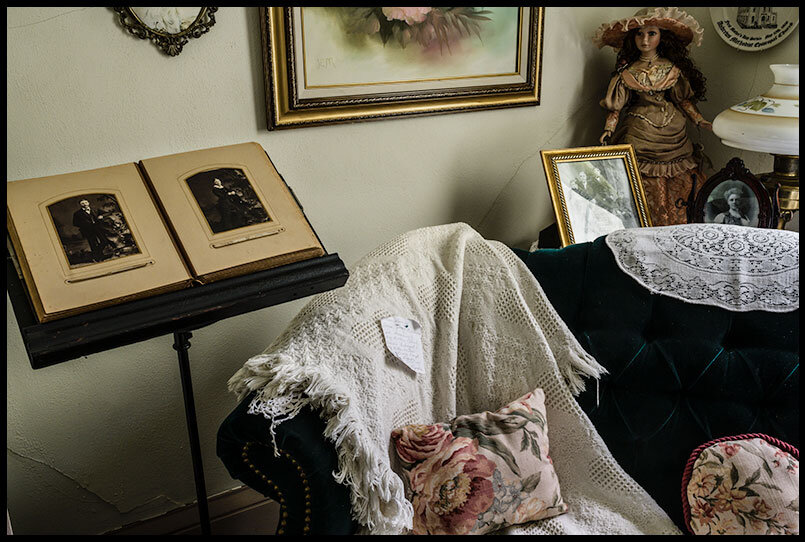
A piece of paper, attached to the quilt, gives an acknowledgement to the person who donated it.
It is a simple gesture, but perhaps that is what makes it so meaningful.
Behind every object is a person.
Behind every person is a story.
And that, ultimately, is the true legacy of Mother’s Day.
The Names We Give Our Hopes
This morning, as I drove from Pittsburgh back to Grafton, West Virginia, I decided to get off the Interstate and explore the town of “Prosperity.” For decades the name has intrigued me - like so many other names of towns across America, with names that make a statement …
August 4, 2019
For decades I have been fascinated by the names of small towns scattered across America—places whose names seem less like locations and more like aspirations.
This morning, as I drove from Pittsburgh back to Grafton, West Virginia, I left the Interstate in search of one of them: Prosperity. Like so many towns across America, its name seemed less a description than a declaration of hope by those who first settled there.
While searching for Prosperity, I first came upon the town of Amity.
Amity—a word meaning friendship, harmony, and goodwill.
Only one road passes through Amity. Two churches face one another across Highway 19—a Methodist church built in 1867 and a Presbyterian church completed seven years later.
Continuing on, I finally arrived in Prosperity—named after “the optimism of its settlers.” The town was much like Amity, although it appeared to be in a somewhat better state of upkeep. Houses lined both sides of the road, some with small front yards. The town sits at the “Y” where Highways 18 and 221 meet.
Having left Prosperity behind, I made a few wrong turns and eventually found myself, as best I can determine, near the town of Good Intent. Seven houses, a Presbyterian church, and a weathered barn stood along West Union Trace. The barn appeared to have witnessed countless seasons come and go.
As though framed within the doorway like a photograph hanging on a wall, a reddish-brown horse stood facing left. It was the only sign of life within the town.

Each time I drove through—which was three times, nearly back to back—there was not a person, dog, or cat in sight. It was as if all life had vanished, or had become quietly sequestered within the walls of the houses scattered across the surrounding hills.
With each of these three towns, I wondered if their namesakes ever became reality.
Perhaps the people who founded these towns understood something we often forget—that communities begin not with certainty, but with hope. Their names were not simply descriptions of what existed; they were declarations of what they believed might one day become possible.
As I continue to reflect on this, I am overcome by a sense of the hope that must have filled these early settlers as they established these places. There was a time when these towns existed only as an idea—when the landscape before them was unsettled, and people were stepping into uncertainty in search of a new beginning.
They were not simply building homes and streets. They were creating a future they could not yet see.