
What Waffle House Taught Me About America
Just after I moved to Nashville, I became aware of the Waffle House restaurants. At first I considered them as a typical “greasy spoon”, but quickly came to realize that they are much more…

Waffle House/Millersville, Tennessee
When I moved to the South more than a decade ago, I discovered Waffle House. At first, it was simply another restaurant that dotted the highways and back roads of the South. As I began traveling those roads more frequently, I found myself stopping at these somewhat iconic restaurants. Initially, I was unimpressed. But over time, I became hooked.
At first, I think it was the predictability that drew me in: the familiar menu, the familiar food, and the familiar atmosphere. Eventually, I realized there was another kind of consistency—the people who ate there and the people who worked there. Waffle House has a culture all its own, a distinctly American subculture, a kind of melting pot.
Every Waffle House has its regulars and its transients. No matter where you are, there are similarities that connect them both. But what has fascinated me most over the years is the culture of the people who work there.
On the surface, there is the language—one I eventually learned to speak myself when ordering: "Pull one sausage. Hash browns, scattered, well done."
Beneath that language, however, is something deeper: craftsmanship, pride, and an unmistakable sense of competition, especially among the cooks. From time to time, I have overheard them comparing how many orders they pushed through during a shift, or talking about the legendary cook at Store #537 who still holds the record. There are bragging rights. The veterans mentor the newcomers, teaching them how to keep pace with the relentless rhythm of the grill while maintaining Waffle House standards. There is pride in the work.
But sometime around midnight, usually between 12:00 and 1:00 a.m., the culture of Waffle House changes.
It is much like the ocean, where one world exists by day and another emerges after dark.
The late-night crowd is made up largely of people coming from clubs, concerts, and bars. Some are customers ending their evening; others are musicians and performers who have just finished a gig. Many are regulars, something made obvious by the easy familiarity between them and the servers who greet them.
The conversations change as well.
During the day, most conversations remain between customers seated at neighboring booths. At night, those invisible boundaries disappear. Patrons and employees become part of the same conversation, voices moving effortlessly back and forth across the counter. The counter still divides the dining room from the grill, but only physically. Socially, it might as well not exist.
I've photographed people in every corner of this country, searching for the places where America reveals itself without performance. Waffle House has become one of those places.
Around these counters, sometime after two in the morning, the labels people carry through the rest of their day seem to lose their importance. Construction workers, musicians, college students, truck drivers, nurses coming off shift, and people with nowhere else to be all find themselves sharing the same space, waiting for the same meal.
It's one of the few places I've encountered where conversation still moves easily across every line we imagine separates us. In a country that often feels divided, that simple fact has become something worth paying attention to.
Why Documentary Photographers Should Listen More Than They Photograph
Immediately, my mind returned to that moment inside a Waffle House many years ago. I remember asking if I could make her photograph. Then, as I often do, I asked a simple question: “would you tell me your story?”
She did.
Needing to tune out the world around me—lawnmowers humming, neighborhood kids making the most of their final days of freedom before returning to school—I slipped on my noise-canceling headphones, opened the music library on my phone, and prepared for a brief escape.
I chose an album I hadn't listened to in several months, one that had become a trusted companion during my six-year, 350,000-mile journey across America for my In Search of America project.
The album was Don Henley's Cass County. One by one, the songs unfolded, each with its own character and story. Then "Waiting Tables" began to play.
My heart opened wide.
As the first notes filled my ears, memories flooded back with remarkable clarity—faces, conversations, roadside diners, small-town cafés, and the people whose lives briefly intersected with mine. The images arrived as vividly as the lyrics themselves, carrying me back to a journey that, in many ways, never really ended.
Over the years, diners and family-owned restaurants became far more than places to eat. They became places to pause, observe, and listen. If you wanted to understand a town, there were few better places to begin.
The people behind the counter knew everyone's name. The customers often did too. Farmers, truck drivers, retirees, third-shift workers, young families, and travelers all found themselves sharing the same room, if only for a little while. I was usually the outsider—the one just passing through—but before long, I felt as though I'd been invited into a small piece of someone else's world.
I was always drawn to the hours most people tried to avoid: before sunrise or long after dark. Those were the moments when the masks seemed to come off. Conversations became quieter, more personal. People seemed less hurried, less concerned with appearances, and more willing to simply be themselves.
Sitting here now, I find myself wondering if there isn't another story waiting to be told—one centered entirely around these places. I have a feeling that when I finally return to the road, the diners themselves may become the journey.
“She married a boy as soon as she got out of school
But he turned out to be a reckless fool
Gone are the days when she was worry-free
Now she's a single mom; she's only twenty-three”
The song brought me back to a photograph I made early in the In Search of America project—a young waitress on her first day behind the counter. Her story was almost a reflection of the lyrics I was hearing.
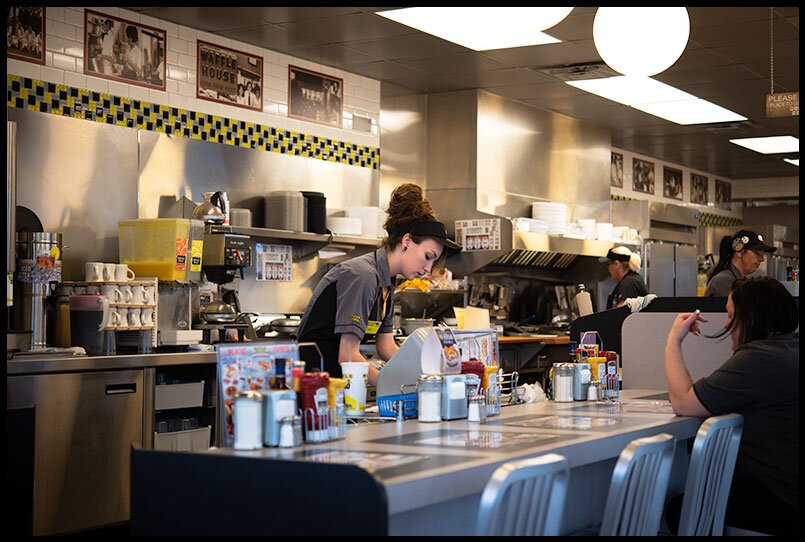
Immediately, my mind returned to that moment inside a Waffle House many years ago. I remember asking if I could make her photograph. Then, as I often do, I asked a simple question: “would you tell me your story?”
She did.
How many women's lives echo the story behind that song?
How many times have we sat in a diner or restaurant, accepted a cup of coffee or a plate of eggs from someone, and never stopped to wonder who they are beyond that brief interaction? What struggles have they carried? What hopes are they holding onto?
I've always tried to ask.
And when someone chooses to share their story with me, I do the only thing I know to do—I listen, with my heart wide open.
The Boy in the Old Brown Jacket
This morning I read a comment left by a friend of mine regarding my post on Tribalism. The comment made reference to the “family” tribe, and the detriment that its breakdown - its disintegration has caused within society.
The family tribe is perhaps the most important of all tribes, as it is the foundation of one’s identity. As I pondered this I realized that [traditionally], within each tribe are the ‘sub’ tribes - family being the most important of these. If the family tribe broke down, the overall tribe would take over - assimilating the remaining members of that family into the larger family.
This too has been lost among much of society - especially within what is commonly referred to as the “inner city”. When family units break down, gangs tend to take over the role of family - providing that foundational identity.
I can speak to this with some authority based on my own upbringing. The “pondering” I mentioned at the onset of this writing has illuminated my own experiences regarding this foundational identity.
I was put up for adoption at the moment of my birth. To be honest I don’t know if I was ever held, even for a moment, by my biological mother. Fortunately for me I was adopted within several months of my arriving into this world, by a very loving family: parents, grandparents, aunts, uncles, and cousins. I was raised as one of their own. I was told early on, by my parents, that I was adopted. If recollection holds with accuracy, I was probably about four years of age. It was also brought up a few times throughout my life - especially in my mother’s final year of life. All this to say that it was never allowed to become ‘an issue’ - an “elephant-in-the-room.
When I was eleven years old my dad died, and two weeks later my grandpa died. These were the foundational male role models in my life. In many ways my entire foundation collapsed within that two-week period. I still remember, with great clarity, the deep sense of bewilderment that I experienced, as well as the deep sense of suddenly being untethered to anything. As I write this I can say now that the experience of being untethered can be equated to what I imagine it would be to be in outer space - outside of the spaceship without any cord to restrict my connection.
I felt so utterly alone.
I even remember specific instances; one where I just stood outside the house, as if I was disconnected from it as well. I was wearing this old jacket. I don’t even remember where I got it. It was well-worn, and sort of a muted plaid color of browns, and it had rather large buttons. I mention this because I relished in the fact that the jacket was “old” and “worn”. It was not new and nice - and this had great significance for me at the time - although I still have no sense as to why - nor did I then. I do remember feeling that ‘I didn’t deserve anything better than this old worn jacket’ - that in some way it seemed to be representative of me… I can still feel that jacket.
I remember, as well, standing in the back of the church, during Sunday mass - and yes, wearing that jacket. I remember just standing there not wanting to go in. As one passed through the main doors of the church’s front entrance, there was an area probably twenty feet in depth before one would pass through a second set of doors that opened into the church itself. It was in that area that I stood. A few times one of the ushers, who was seated in the back pew, would walk over to me to encourage me to come inside. It wasn’t because he was being kind, in fact it was the opposite… But each time I refused is encouragement. I just stood there with the same deep sense of ‘not belonging’. And the feeling of that old coat was just as it was as I stood outside of the house.
Life continued on, and my connection to this family was never left to any doubt. At no time did I ever feel as if I were not part of this family. Yet, in hindsight, there was a part of me that always felt disconnected - but this feeling was brought on by me, and not from the treatment of others. Would I have felt this disconnection had I never known that I had been adopted? I don’t know. Something tells me that the answer is “yes”, but this is only speculation on my part. Only “speculation”, but one that is based on a deep feeling within me that I was “disconnected” somehow - yet I must question if this ‘feeling’ only surfaced after the death of my dad, and my grandpa.
Later in life, due to various circumstances, my relationship with aunts and uncles, and even cousins, seemed to drift apart. First with those on my mother’s side of the family. In fact, it was after my mother died that this drift began… and this brings up another tangent of the family foundation:
When I was younger we would have dinner every Sunday - most often with my mother’s side of the family. It was a family gathering of the entire extended family. Generally it was a pot roast with roasted potatoes and carrots - still one of my favorite meals. This tradition carried on until my Grandmother died - by which time I was in my late twenties. After she died these gatherings ceased with somewhat of an immediacy. The cohesiveness of the extended family vanished, and it became fractured in many ways. After my mother died that fracture became even more pronounced and, in time, I lost contact with that side of the family. It was after my mother died that I also began to feel the sense of ‘not’ belonging.
On my dad’s side of the family I had maintained a close contact with my cousin Carolyn over the years. Eventually, when I was in my late forties, I reconnected with much of that side of the family as well. I was invited to the annual reunions - which I attended. And it was at one of the reunions that the subject of my “adoption” came up - not in a negative way, but more from a point of clarity. As time went on I began to feel as if there was a light chasm between us. I blamed this feeling on myself. Then there was a break in the cohesiveness. Suddenly I was set adrift by this part of the family - and to this moment I have no idea why. The connection had been broken by them.
So in pondering the comment that led me to this writing, I am struck by the importance of the “family tribe”, and the power that it provides us - or keeps from us. I mentioned early on in this writing about the formation of our “identities” that comes from the family tribe. For me, I had an identity that was formed by the family tribe. Yet mine was an identity that remained in flux - until it finally revealed itself as a false identity.
I once encountered the concept of a “stable datum”—the idea that human beings require a foundational point of certainty from which to understand the world. Whether or not one accepts the broader philosophy from which this concept originated, the idea resonated deeply with my own experiences.
The premise is that when this foundation is weakened, the individual can begin to feel as though the very structure of their life is beginning to collapse. I have witnessed this in many aspects of life, both in others and within myself.
Looking back over the moments I have described in this writing, I can see a recurring pattern: each time a foundational connection was weakened or lost, I found myself set adrift. I questioned who I was, where I belonged, and ultimately, what my relevance was in this world.
This constant flux has been a double-edged sword for me - one that has caused great conflict within me - and presumably throughout the entirety of my life. I have always been good with being a solitary being. I have embraced, and oftentimes even insisted on being left alone. Being alone was, and is, my sanctuary. Yet I also crave the connection of a tribe - the sense of belonging to something greater than just myself. This caving has manifested itself in many forms throughout the decades - yet each time I never feel fully connected to the tribe. I always feel that I am still the “outsider”. In some ways, I suppose, I will always be that eleven year old boy in the old, worn, brown plaid jacket who is standing outside of his house, or in the back of the church, adrift…
Beyond the Headlines: One Ukrainian's Story of Living Through War

I have intentionally distorted this photograph to protect Anna's identity. But the distortion also serves another purpose. It reflects what life has become for her—and for millions of Ukrainians living under the shadow of this war. Their world has grown increasingly blurred, its colors slowly fading, even as their suffering slips from the attention of much of the world.
Ever since Russia's full-scale invasion of Ukraine began, I have wanted to document it. Circumstances have kept me from going.
Not a day passes that I don't think about the people living there. What troubles me almost as much as the war itself is how little sustained attention is given to the ordinary Ukrainians enduring it. Headlines report military advances and political maneuvering, but they rarely linger on the quiet cost borne by those simply trying to survive.
My dear friend, Anna, lives in Kyiv. We stay in touch through social media—the only reliable way we have to communicate. During the first year of the invasion, I also met periodically, through virtual technology, with a small group of Ukrainian women who were teachers. More than once, as we talked, our conversation was interrupted by the unmistakable sound of explosions. It was surreal to be sitting safely at home while they calmly continued speaking from a city under attack.
Every so often, Anna sends me a photograph of herself. With each one I notice the same thing: a little more weight lost, a little more light gone from her eyes. The youthful spirit I once knew has gradually been replaced by exhaustion. There is a weariness in her expression that no one should have to carry.
For now, my own injuries make the journey impossible. But when I have fully recovered, if the war continues, I intend to go on my own dime. I don't want to photograph battlefields nearly as much as I want to witness the lives of those caught in the middle of them—the families, the teachers, the elderly, the children, the people whose stories are too often overshadowed by maps and military briefings.
Imagine living in a place where you never know whether you will wake the next morning, or whether you will survive the coming day. Drone strikes arrive without warning. A building standing one moment can be reduced to rubble the next. Air-raid sirens become part of the rhythm of everyday life.
I remember talking with Anna during one of Kyiv's bitter winters after Russian attacks severely damaged Ukraine's electrical infrastructure. Entire neighborhoods were left without heat while temperatures remained well below freezing. It is difficult to comprehend that reality from the comfort of a warm room.
In a recent message, Anna told me that many Ukrainians are now fearful of another winter without reliable heat. She worries that limitations on Ukraine's air-defense capabilities could leave critical infrastructure increasingly vulnerable to future attacks. Whether one follows the war through politics or military analysis, it is easy to lose sight of what those decisions ultimately mean: families wondering whether they will have electricity, warmth, or even a home when winter arrives.
That is the Ukraine I hope to document—not the machinery of war, but the resilience of ordinary people determined to live despite it.
For millions of Ukrainians, however, it was simply another day of enduring a war they never chose.
I have decided to present the most recent email I received from Anna, so that you can read from her own words.
________________________________________________________________________________
Life in Kyiv During the War
by Anna Tkachenko
The following letter was written by my friend Anna, who has lived in Kyiv throughout Russia's full-scale invasion. I have reproduced it with her permission, exactly as she wrote it.
“Every person carries within them an entire world — a world of memories, dreams, losses, hopes, and encounters. Some moments of life fade from memory like footprints in the sand touched by the wind, while others remain forever in our hearts and souls.
We all have our own unique life story. It contains joy and sorrow, triumphs and setbacks, moments when we wanted to laugh with happiness, and days when it seemed that the whole world had become too heavy to bear. Yet it is precisely these moments that make up the story of a human life.
I was born in the beautiful city of Kyiv, a city with a rich history. It is a place that has always inspired me. My childhood, like much of my life, was not easy. I remember the days when we had almost no food at home and how my sister and I would rejoice over pasta with cheese as if it were the finest meal in the world.
Life in Ukraine in the early 1990s, when the country gained its independence in 1991, was difficult primarily because of a deep economic and social crisis. It was a challenging time for many people. Yet it was also a period of great hope. For the first time in many decades, Ukraine became an independent nation, gaining the opportunity to determine its own future, develop the Ukrainian language and culture, and build its own state institutions.
My childhood took place during difficult times. Yet the greatest hardships were not only about a lack of money or the uncertainty of the future. My father was a cruel man, and because of that, our home did not always offer warmth or a sense of safety. Some memories still hurt, even though many years have passed.
However, those trials taught me to be strong, to empathize with the pain of others, and to value people who bring kindness into the world. Even now, because I am unable to live separately, I have to remain under the same roof as the person who destroyed my life and my dreams—the person who made my mother cry every day. That is deeply painful.
Sadly, many women go through the same kind of hell.
My father started a family to be like everyone else, but he never truly cared about his wife or his children. He lived only for himself.
When my younger sister was born, he bought neither food nor clothes, nothing at all. I had been studying to become an interior designer, but I had to give up my dream in order to provide food and clothing for my mother and little sister. Unfortunately, at that time there was no opportunity to both study and work at that university. Students could only begin working alongside their studies after two years.
It was a difficult period. My mother had broken her leg and was unable to work, and my younger sister was still very small. I could not wait that long, so I left university and went to work.
I hardly had any days off. I worked fourteen hours a day. Sometimes I felt as though I could not endure it any longer and was ready to give up, but I knew I did not have that choice. I was responsible for my mother and my little sister, and they depended on me.
I remember that time... When I was working, I never bought anything for myself and barely had enough to eat. Later, my boots tore apart. They were autumn boots, but winter had already arrived, and I kept wearing them in the freezing cold with a hole in the sole. My boots were always wet and cold. One day, I became seriously ill and almost died.
There was so much in my life—so much pain and disappointment. Yet even now, I still believe that one day everything may change.
Every person should live with hope in their heart and, even in the darkest days of life, keep searching for the light.
My childhood was not easy either. I remember working to earn money for my school notebooks and uniform. I simply knew that life was difficult for my mother, and I wanted to help her in any way I could.
At that time, my mother paid for my English lessons, which were very expensive. My mother has always been my light and my hope. She taught me that no matter what happens, we should keep smiling and keep dreaming.
Whenever I was given a little money for food at school, I never spent it on myself. Instead, I gave it to homeless people and children. I did this because I believed that, at the very least, I had a bed to sleep in and a home to return to, while many of them had nothing—not even enough food to eat.
There is something truly beautiful about seeing happiness in another person's eyes. Sometimes the smallest acts of kindness, or a kind word spoken from the heart, can give someone hope and help them carry on.
If someone had told me a few years ago that one day I would be writing these words, I would not have believed them.
I would not have believed that ordinary things could become priceless. That silence could feel like a gift. That a simple message saying, “I’m home,” could bring such relief. That a person could live between fear and hope for so long and still find the strength to smile.
I remember mornings without air-raid alarms. I remember a time when the word “war” seemed like something distant, something that belonged only in the pages of history textbooks. I remember dreams that were easy to build, as if the future were something guaranteed.
Then the war came. Nearly five years have passed since the beginning of this bloody war.
It changed more than just the country. It changed us. It taught us to count our days differently, to value simple things, and to find courage where we had never thought to look for it before. It showed us how fragile life can be and how strong the human heart can become.
My life, like the lives of millions of Ukrainians, has been divided into two parts. There was a “before” — filled with ordinary worries, plans, dreams, and hopes. And then came the “after” — when every day became a reminder of how fragile the world we once believed to be unchanging truly is.
War takes away so much. It steals peace, a sense of safety, and confidence in tomorrow. But it also reveals things that people often never realize they possess: the strength of their own hearts, the value of human kindness, and the ability to find light even in the midst of darkness.
Every new day is a gift, and every moment of life is priceless. When you live in a country at war, you do not know whether tomorrow will come for you. It is like a roulette wheel — you either survive or you die. It is a lottery of life and death.
At first, you do not want to accept that life can end at any moment. You resist the thought and try to hold on to the belief that there will always be another tomorrow. But with time, you simply learn to accept it and understand that it has become a part of this harsh reality.
The war changed everything.
It taught us to live from one air raid alert to the next, from one news update to another. It taught us to cherish every message from our loved ones, every phone call, and every morning when everyone was still alive. It brought a pain that is difficult to put into words, yet at the same time it revealed the incredible strength of the human spirit.
I have seen fear. I have seen tears. I have seen the exhaustion in the eyes of people who continued to live despite everything. But I have also seen courage, kindness, and resilience. I have seen people helping strangers, supporting one another, and finding the strength to rise again after the hardest blows.
I pray that one day we will wake up under peaceful skies. This is my wish for everyone in this world who is living through the horrors of war. “
The Importance of Tribes
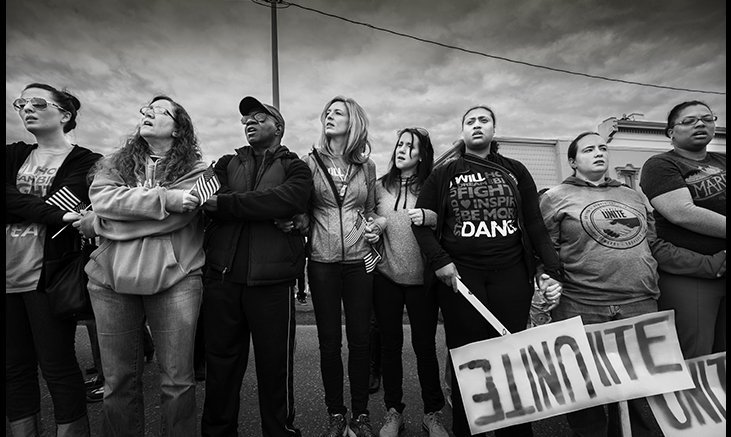
When most people think of “Tribes” they tend to think of it in terms of American Natives, or those who live in the remote locations hidden within the Amazon. But in reality we all live among tribes - and in many instances we live among multiple tribes simultaneously.

Supporters at Vigil for Bloody Sunday Anniversary © David Robert Farmerie
When most people think of “Tribes” they tend to think of it in terms of American Natives, or those who live in the remote locations hidden within the Amazon. But in reality we all live among tribes - and in many instances we live among multiple tribes simultaneously.
Sports teams, churches, social organizations, politics, and so on are all forms of a tribe. Over the past couple of decades many of us have entered into - what I refer to, as Micro Tribes. These tribes have been sparked into existence by the social media platforms - beginning as far back as the inception of the internet, and AOL (America On Line).
When MySpace entered the picture we were introduced to “Blogging” for the first time, as well as the ability to build a community - a tribe, comprised of people from all over the world. During these early years the Tribes were more generic - much like the more modern-day communities that are comprised of people with varying interests and backgrounds that found commonalities with one another. As time moved forward, as well as the evolution of social media platforms, ie: Facebook, which was introduced in February of 2004 these communities began to evolve into tribes - where people came together with more specific commonalities: family, friends (as in actual friends), and acquaintances. In late 2010 we saw the introduction of Instagram, which grew to one million users within the first year. By mid-2018 Instagram had one billion users.
Through the evolution of these two platforms people began migrating into the “micro-tribes”. Because of the worldwide connectivity of these platforms, as well as the huge number of users, people were able to narrow their tribes to very specific criteria. As an example, now it was no longer political parties, but rather specific ideologies within a political party, and eventually these ideologies became even more specific - hence “micro-tribalism”: I like A, and B, but I don’t like C. If you are in agreement then you can be part of my tribe; but if you like A, and don’t like C, but are ambivalent regarding B, then you cannot be part of my tribe.
What I have discovered, through hundreds of conversations while on the road with the In Search of America project, is that this micro-tribalism was born out of a seemingly ever-increasing fear among members of a society. And as fear increases, the desperation to find a refuge of safety becomes more and more imperative. This is why tribes were created in the first place - to provide safety from outside threats: wild animals that found you as their prey, territorialism and others encroaching on your hunting grounds, and even community cooperation for hunting and, eventually, agriculture. It all boiled down to the same thing that it does today: safety in numbers.
The issue now, with micron-tribalism, is that such narrow focus blinds us to possibilities that might help in relieving our fears - such as learning the truth about something as opposed to believing in the propagandas that are perpetuated by those who benefit from us being in such deep fear.
Tribes, however, can be of great benefit to us - for reasons other than the feeling of safety. As an example I look at the Artist’s Salon that Gertrude Stein had each week at her apartment in Paris - in the early 1900’s. People - mostly artists, would gather each week to socialize, discuss art, and life in general. Out of this Salon emerged the artists that we now revere for their works: Matisse, Picasso, Hemingway, Sinclair Lewis, Ezra Pound, and so on.
In the 1940’s and 1950’s another tribe of artists emerged - this time in the United States. They became known as the Beat Poets. They began to organize, as a movement, in the 1940’s, but then more formally came together in the 1950’s, in the Bay Area of San Francisco - and more specifically, gathered at City Lights Bookstore, owned by publisher, Lawrence Ferlinghetti. Out of this tribe came writers and poets such as: Bob Donlon, Neal Cassady, Allen Ginsberg, and Robert LaVigne,
Modern day tribes provide more than just a perceived security. They can also provide nurturing, and mentoring. Most of all modern day tribes provide a synergy - regardless of what the tribe is based around: art, politics, gardening, food, etc. When two or more come together under a common mind, a synergy is created that becomes more powerful than any one individual.
Also, as part of a tribe, one has a community of like-minded individuals to contemplate with, explore ideas and thoughts with, in a trusted safe environment. It is important to understand that being “like-minded” does not mean that each person is the same as the other. Being “like-minded” refers to having core beliefs in something. The danger, however - which is what I see so much of now with micro-tribalism, is that people seek out others who not only share core beliefs, but they also seek out - and even demand that each member of the tribe “thinks” the same as them. When we lose the diversity of thoughts, vision, and ideas, we lose the ability to see the full picture.
I am reminded of something that former Tennessee Senator, Howard Baker Jr. had said - and I am paraphrasing a bit; ‘Essentially he said that partisanship is about drafting new ideas and policies. Bipartisanship is about flushing out all of the details to make sure nothing was missed.’
If we only look at situations with our own myopic vision we will never be able to see the entirety of anything. In micro-tribes we cannot “see the forest through the trees”, nor can we see anything but the trees - including obstacles, pitfalls, or optional - and quite possibly better pathways.
Many years ago I was part of a group of eight photographers who started a Salon. Our purpose was to create a group of “like-minded” individuals - all with an expertise, as well as a dep passion for photography. Each of us were well-accomplished photographers, but each from a different discipline of photography. And it was from this diversity of disciplines - differences in how we engaged in photography, that each of us grew significantly within our own disciplines.
Keep in mind that a great soup is made up of more than just one ingredient. The richest flavors come from the synergy of many ingredients melding their individual influences together.
Which brings me to the close of this piece by relating an analogy that I have repeated many times:
When we are born we are like a cauldron of water simmering over a low fire. With each experience - good or not so good, it becomes an ingredient for our soup that we call life. At the end of our lives it is this soup that we leave behind for others to dine on.. What kind of soup do you want to leave behind: one that will be full of the most amazing flavors that enrich the hearts and souls of those consuming it, or one that will be rancid, or simply have no flavor at all?
The choice is ours…


Time In The High Desert
The High Desert is much different than all of the other types of deserts. The most noticeable is that there are no large cactus here. In fact, the only cactus found here are small, and low to the ground. But the color palette is one that soothes my soul just by being surrounded by it. And then there is the [light].
The High Desert is much different than all of the other types of deserts. The most noticeable is that there are no large cactus here. In fact, the only cactus found here are small, and low to the ground. But the color palette is one that soothes my soul just by being surrounded by it. And then there is the [light]. It is the quality of light that has been sought out by artists, and painters, for centuries - especially the early morning, and late evening light. There is the silence, accentuated by the subtle sounds of small birds, or the occasional passing dove, or Raven. Even the near-constant breeze, which sometimes escalates to a wind, has its own sound, that is perfectly compatible with everything else. And when the breeze pauses, there is a stillness that is felt with the entirety of one’s being.
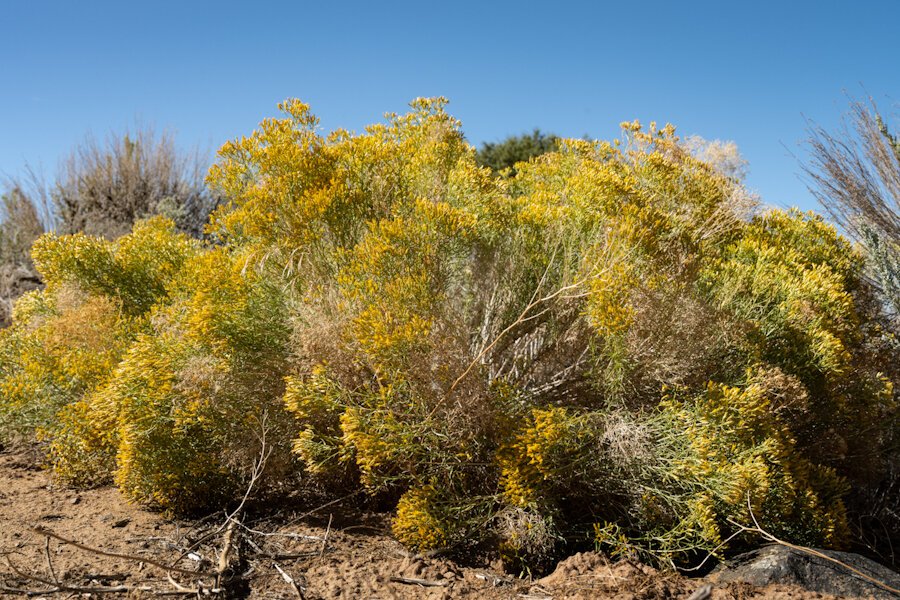
The tan color of the earth holds a visual background to the blue-greens of the sage. Dotted about the landscape are small, dome-shaped bushes covered in tiny yellow tips.

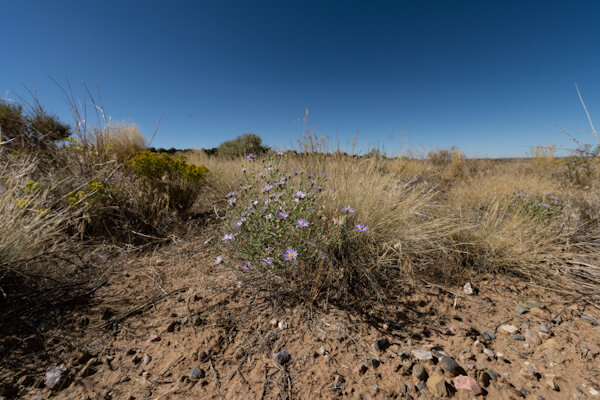
And the occasional deep green of the Juniper Cedar Tree that looms above everything else - but as one draws closer, the heavily textured, and twisted surface of their trunks is a visual splendor in, and of itself. As one walks across the High Desert landscape, they will be treated to tiny flowering plants, that remain close to the ground, each bearing tiny flowers - some yellow, and some purple. These offerings cannot be scene by the viewer who simply stands at the edge, and gazes at the overall. These gems are only for those who venture into the landscape - to experience it as nature intended it.
And then there is the rejuvenating scent of sage, as one wraps their hand, ever-so-gently around the tops of the plant, as they continue to walk. The skin is embed with the scent, that one can hold to their nose, and breathe in deeply - time and time again. When the scent fades, simply allow the hand to rub over the tops of another plant.
When one stands back, and observes the landscape of the High Desert, overall, it appears as a soft palette of color, and texture. But when one explores closely, one is made aware of the resilience, to the harsh environment, that is built into each of these plants. Root systems, of these plants, for the most part, grow straight down, into the earth - for any semblance of moisture, and to protect themselves from the harsh rays of the intense sunlight.

Yesterday I spoke with my friend, Peter, who explores the nuances of the desert, frequently. Peter is also an aficionado in the art of Bonsai - and is currently experimenting with desert plants that have already had their growth stunted, by the harshness of the environment. he told me of small specimens, that he has come across in the desert, that are as young as 25 years, and as old as 100 years, or more. “They grow slow here”, he said. “But transplanting them from the desert environment, into pots, is difficult”, he continued. “They tend to not survive”.
As I walked in the desert, earlier this afternoon, I began to look at the plants from Peter’s perspective. I came across one (that I felt compelled to make a photograph of]. I have even been contemplating returning to it, and attempting to retrieve it. It is situated in the center of two worn tire ruts in the dirt road. It seems that its only connection to the ground is one center root that has gone deep. the other roots are fully exposed, and driftwood-dry. The plant, even though it appears to be old, is only about 12 inches high; but still it manages to, not only survive, but to bloom its tiny yellow flowers.
I had also brought back with me, from this excursion into the desert, a small piece of tree trunk, or tree branch, that is excessively dried, and weathered. It is only about eight inches in length, or height (depending on how one views it), but it has such a beauty to it. I want to photograph it with my large-format camera when I return home.
The rains have begun again.
Quarantined
It wasn’t until the accident that I experienced the changes in my quarantined status…


My left clavicle broken into three pieces.
Like everyone else in the world, I have been in quarantine since the beginning of March. For awhile I was able to find freedom from quarantine by getting out on “Velvet”, by 1993 BMW motorcycle. But on Memorial Day that all came crashing to a halt - literally, and figuratively. Since then I have been quarantined, more due to recovery, than from the avoidance of COVID.
On Tuesday, the 21st of July, I finally had surgery to put the broken pieces back together - just three days shy of 8 weeks since I had broken the bones.
But this post is not about the broken bones, or the accident. Instead, it is about differing effects, brought on by the different types of quarantine - something that I never would have imagined existed. And how I became aware of this phenomenon was through my photography.
In the early days of self-quarantine, when it was all about avoiding the COVID virus and, simultaneously, not spreading it if I was infected by it, little had changed in my life - aside from the fact that I wasn’t working on assignments. But being sequestered in my home, for me, was no different than any other time I am in between assignments. That is my time to regroup. And the fact that I was able to get out, almost daily, on Velvet, I really wasn’t experiencing a true quarantine.
After the accident the quarantine still had no affect on me; but now, the only thing present in my awareness, was the pain; my clavicle was broken into three pieces, and six of my ribs were broken in nine places. I had no sense of being quarantined. In fact, I relished the aloneness - aside from having to walk the dog a few times a day.
Two weeks after the accident, my wife, and I drove to northern Arizona, so that I could get medical help (trust me, it’s a long story). The three-day drive brought about a limited awareness of the quarantine - with restaurants closed, and the need to wear a mask, and constantly be cognizant of washing my hands after the slightest contact with anything outside the car.
Once in northern Arizona, and being on the Navajo Reservation, the restrictions brought on by COVID were strict, and strongly enforced - but still, I simply felt as if I were between assignments - and, healing from injuries. Now it was a double-side kind of situation. This forced quarantine still, for me, was not forced. Had there been no forced quarantine, by days would have been spent exactly the same way. My primary focus - the focus that occupied most of my waking, and even sleeping awareness was managing the pain, and trying to get the injuries resolved.
It wasn’t until I returned home, and had the surgery, that things changed. Now my quarantine status was (for me) all about the physical recovery process. But after weeks of binge-watching streaming services, and unable to read - because of an impaired vision, I began to crave intellectual stimulation - which, in hindsight, was the result (in large part) of the quarantine. What I realized is that, had it not been for the quarantine, I would have been able to engage in face to face conversation, with others. I would have had the opportunities to debate ideas, concepts, and curiosities, with others. This was the result of the mandated quarantine, for me. It was not about [not] being able to go out. It was about not being able to have anyone come in.
My craving, for intellectual stimulation, was fulfilled [ironically] by binge-watching. But this time the watching was of the intellectual nature - and as an added benefit, it was all photography- related. I still longed for the interaction with others. In fact, that longing had become intensified because of the things I was watching. I wanted to discuss it. I wanted to gain outside insights into it.

After the third day, following my surgery, I began to react - creatively. But even before that, from the moment that I arrived home, after the surgery (it was done as an outpatient), things began stirring within me. Over the past several weeks: eight to be exact, much had begun to change within me. Now that the surgery was done, all of the stresses, that surrounded that, had vanished. No longer did I need to worry, nearly every moment, about shifting my broken bones. No longer did I need to worry about worsening the injuries. No longer did I need to worry about finding a surgeon. All of this was behind me.
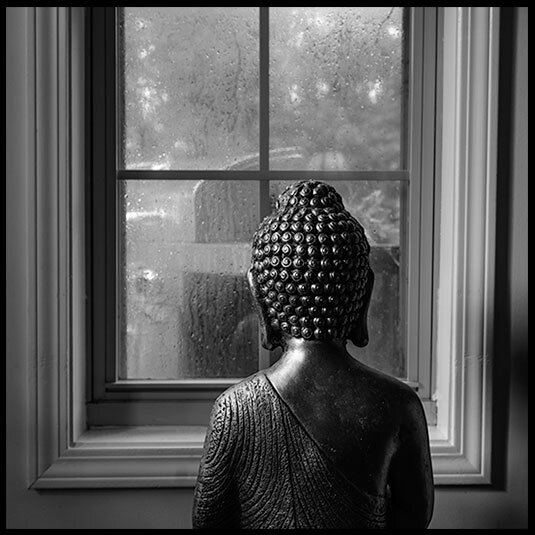
My reaction, on day three, was completely spontaneous. I came out of the bedroom - for what reason, I have no recollection. But what I do remember is seeing a scene - at the kitchen windows that open out onto the deck. They were heavily fogged, from the high humidity outside, pressing against the chilled glass, from the interior air conditioning. Immediately I returned to the bedroom, to grab one of my cameras - a digital Nikon. Quickly - well, as quickly as was possible under the circumstances, I returned to the scene, made a series of images, and then abruptly stopped… I needed to record this scene on film - black & white - of course, with one of my Hasselblads. For the first time, in months - quite possibly, years, I was pre-visualizing in the square format. I was also pre-visualizing in black & white. I was on fire, within. Passion, creativity - they both burned as intensely as they ever had.
The light was fading, rapidly - and the Hasselblads were downstairs, in my office, in a latched hardcase. I would also need a tripod. My left arm was still virtually useless, but I needed it - to unlatch the case, and to carry the camera, and tripod upstairs in one trip. I also needed both hands to secure the camera to the tripod head. I did what needed to be done...

Calico asleep on my bed…

Mr. B pretending that I don’t see him…
The day before, while the rains fell in a deluge of repeated downpours, I found myself making images of the curtains that cover the master bedroom windows, as well as photographs of the view through barren bushes detailed with raindrops. I had even begun photographing the cats, as they laid on the bed - something that is never permitted (cats laying on the bed - not “photographing” the cats). I was photographing what I felt - translating my emotions lossless-ly. I had returned to the core of being an image-maker, and a visual storyteller. I had returned to life.

Bedroom Curtains
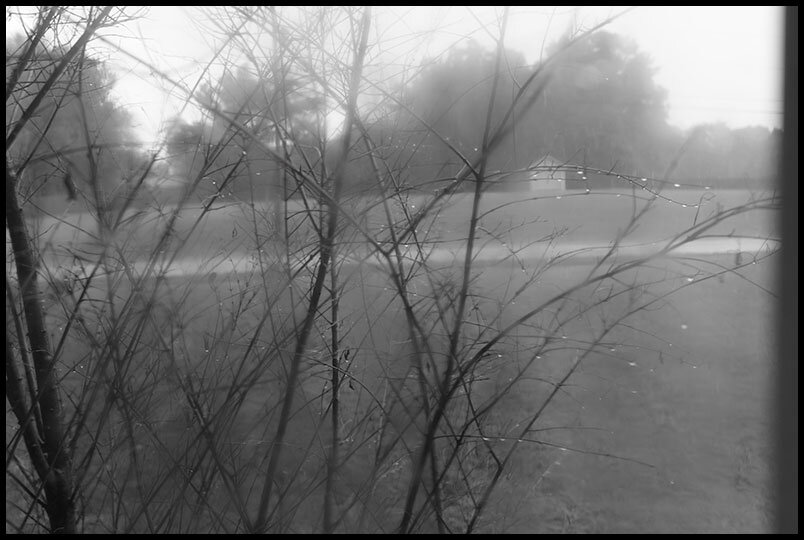
View from the Master Bedroom window.
Photographing Helen Greyeyes

June 22, 2020
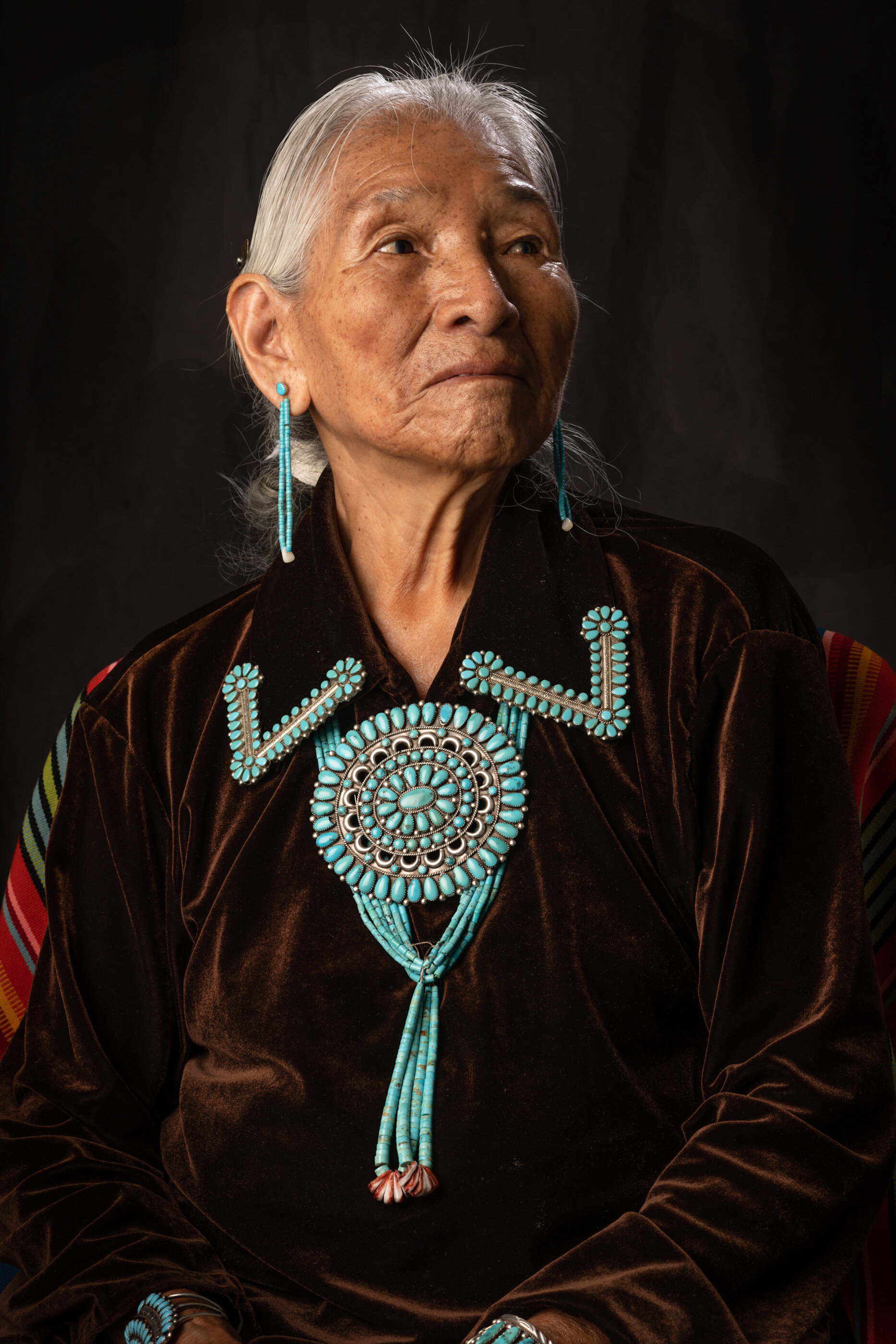
Yesterday I drove to Helen Greyeyes’ house specifically to photograph her. One week prior I visited with her, since it had been several months since my previous visit. I also wanted to make the arrangements for yesterday’s photo shoot. My goal was to photograph her weaving on her traditional loom, and then to make a formal portrait of her.
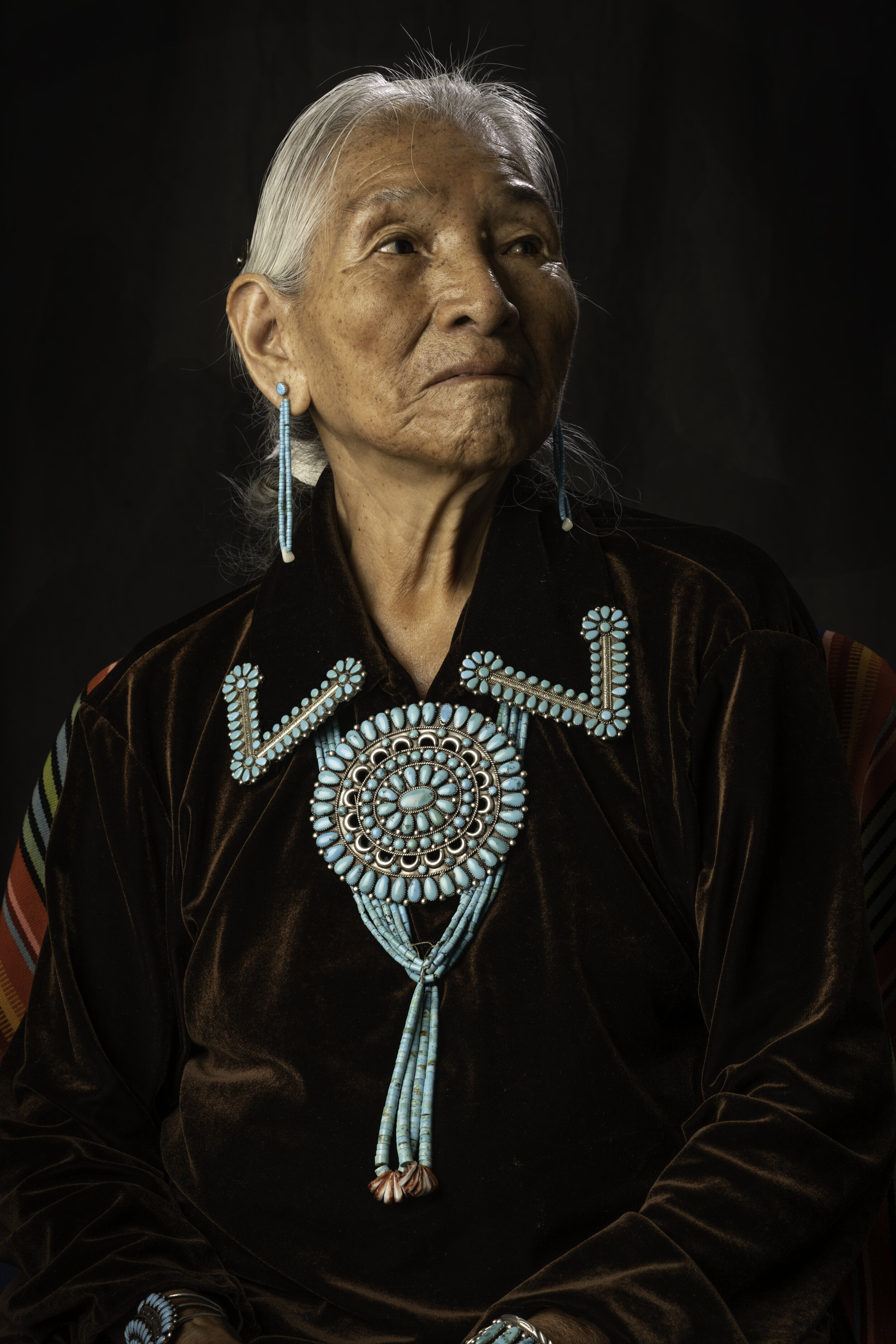
When I arrived Helen emerged from a small room off of the dining room. I was stopped dead in my tracks. She was adorned in her finest jewelry - all made of silver and turquoise. This, in Navajo tradition, is a sign of status. Helen’s silver hair was pulled back tight, and fashioned into a short ponytail that was wrapped in carefully in cord. The silver hair, and the silver and turquoise jewelry, all set against her darkened skin, and her finely chiseled features, was something of truly authentic beauty. Her age, of 83, could not be seen. She was timeless.
It was at that moment that I decided to make her portrait first, and then the weaving.
But before any of that could take place, we sat down to eat. In honor of my visit, Helen’s sister, Alice, made Navajo Tacos so that we could share a meal together - the “Breaking of Bread”, as it were. This was a great honor.

It took some time for me to set up a studio in Helen’s ‘other’ house - a mobile home that sits beside her daily house. Even though it is larger, Helen continues to live in the much smaller house. Living in the larger space, for just one person, would be greedy, in a sense - taking more than she needed. It is part of her traditional Navajo ways.
As I made the portrait, and the photographs of her weaving, I was treated to the ongoing dialog between Helen, her sister, Alice, and her daughter, Rena. The language has such a beautiful sound to it. One can hear its antiquity - as it has continued to flow through time.

And again, through both the portrait session, as well as the photographing of the weaving, there was this unspoken duality: the antiquity, and traditions of her attire, of her language, and of the way that she sat on the floor, in front of her loom, weaving - juxtaposed against the photographic lights, the cameras, and even the interior surroundings of her mobile home. And I was a part of it… For the better part of four hours, I was granted a glimpse of something that has been, for millennia.
Members of my Patreon site can see “Behind The Scenes” video from this shoot! Go to: https://www.patreon.com/davidrobertfarmerie
Boquillas, Mexico: Part 2
For those traveling to Boquillas, from Big Bend National Park, they make their way through the immigration station that is located within the park. As one exits through the out door, they walk down a dirt path that meanders through a stand of trees. At the far end is the Rio Grande River.

For those traveling to Boquillas, from Big Bend National Park, they make their way through the immigration station that is located within the park. As one exits through the out door, they walk down a dirt path that meanders through a stand of trees. At the far end is the Rio Grande River. On the other side of the river, which one can easily see, there are always a group of men - and a few row boats. Just simply wave your hand and motion for them to come and get you. A man will row is boat across, help you in, and row you the the Mexican side of the river. There you will pay you fee: $5.00 USD, in cash. That provides you with a round trip boat ride.

Adrian rows the boat from the Mexico side of the river, to the U.S. side to pick up passengers for Boquillas.
Then you will have option to ‘walk’ into town - which is about one mile along a rutted dirt road; or you can hire a truck to drive you into town. But theist alternative - in my opinion, is to opt for the Burro ride. Both the truck, and the Burro are an additional $5.00 USD, in cash, for a round trip ticket.
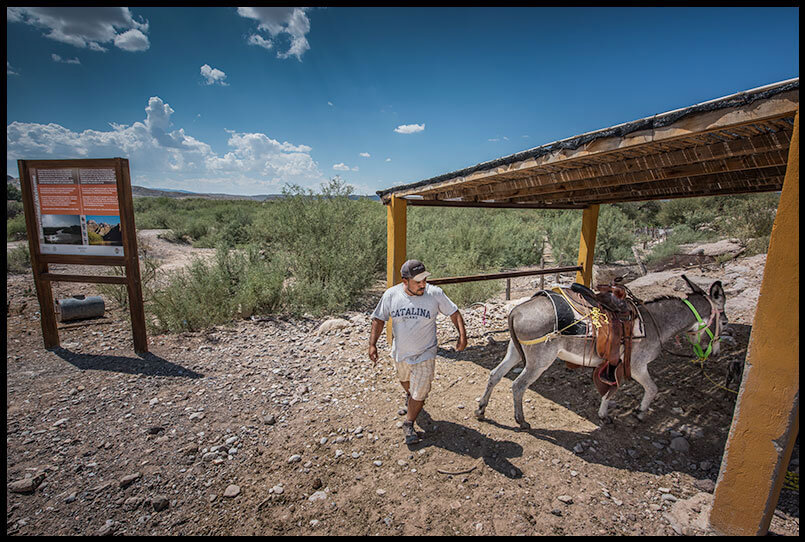
Phillipe parks his mule after bring a tourist into town. The mule will remain there until it is needed for the trip back to the boat.
You will also be asked if you want a guide. You can get by without one, but if you have the means, why not support their economy. In my experience, when I have asked the guides how much their fee is, they simply say “what ever you want”. Be generous, please. As an FYI, I use Philippe whenever I can.

Jose Falconi’s Restaurant in Boquillas - located on the left as one enters into the village.
In the village of Boquillas you will need to check into Mexican immigration. It will be helpful if you can communicate in Spanish. But if not, you’re still get by. At times there is also an “ Entry Fee” , which, as I recall was $5.00 USD, in cash. As one enters the village, there are two restaurants - one on either side of the main road. Both are equally good, but my preference is the one on the left. My suggestion is that you treat yourself to two meals, while in Boquillas - thereby sampling both places.
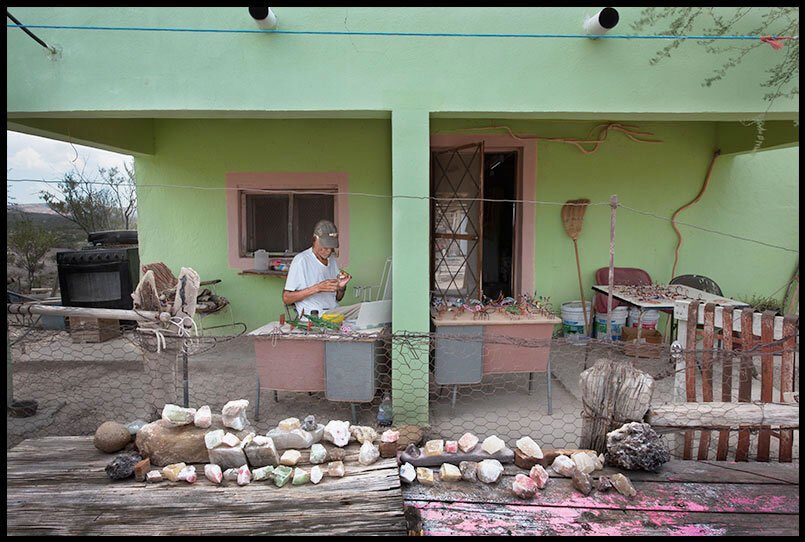
Walking along the main street there are vendors at nearly every house, and each vendor is selling the same thing: fabrics, and wire animals are the main items. About half way down the main street, on the right, is a small green house, where Pablo lives. He sells the best wire animals. He also sells rocks, which are a great deal - except, they will be confiscated by U.S. Immigration when you return to the U.S..

Pablo, sitting on his porch, making wire animals to be sold to the passing tourists. This is Pablo’s only source of income.
Boquillas is a charming village, albeit severely depressed, economically. But there is no crime - that I have ever experienced, or even heard of; and the people are welcoming. one can walk through the entire village in about an hour - a bit more if you want to browse the various vendors. Depending on the season, Boquillas can be hot - as there is no shade.
For me, I also find a great romance to Boquillas. It is a place where time stood still. It is a glimpse into the authentic rural Mexico - and again, without the crime. Depending on the time of year, one may see matresses laying in the front yards of people’s homes. They are not thrown out as junk - as one may see in parts of rural America; but rather, they are there for sleeping. At certain times of the year, the daytime temperature get so high that the houses cannot cool down inside. So people will sleep outside, under the stars, on their mattresses.

The scene along the main road through Boquillas, Mexico
There is a school, a church, and a small medical clinic in the village. A few years ago Boquillas installed a small array of solar panels, providing them with some electricity. The supply is not enough, however, to provide them with power 24/7.

The church in Boquillas, Mexico
Boquillas is a destination for lovers (as the saying goes), but in this case, I belive, it is more for the lovers of adventure, and deep geographical romance - like living in a Mexica version of the movie Casablanca.
There are two ways to experience this very special place: one is to experience it as a tourist. The other, and the one that I highly recommend, is to experience it as the adventurer, and the hopeless romantic. Find your Hemingway, or even your Indiana Jones within yourself. Disengage from any preconceived notions that you may have, and enter into this adventure completely naked - emotionally that is; and if you do, you will return forever changed - for the better.
_David
Boquillas, Mexico: Part 1
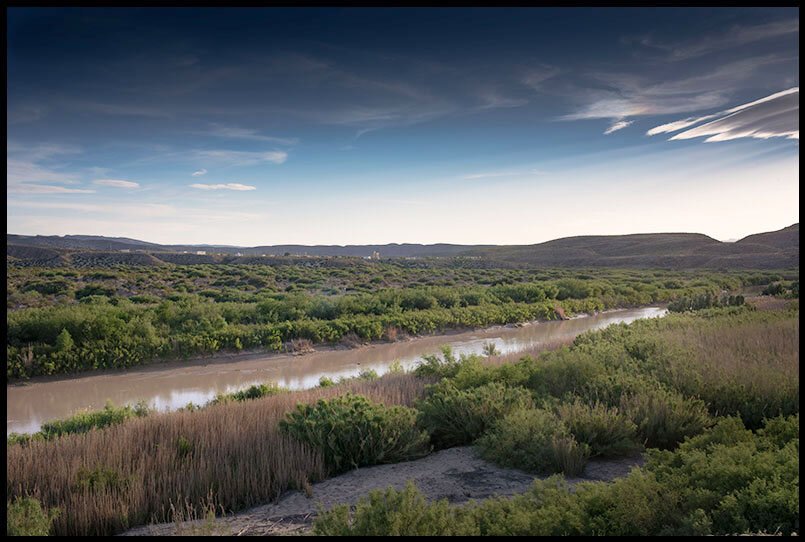
Boquillas, Mexico is a small village just across the Rio Grande River from Big Bend National Park, in southern Texas. In the early 1890s silver was discovered in the Sierra del Carmen, whose northern tip lies just east of Boquillas.

The Rio Grande River which is the border between the United Staes, and Mexico.
I originally ended up in Boquillas while I was photographing a story on “Border Towns, along the U.S. Mexico Border. Since that visit I have returned several times. It has become a destination of the heart.
Boquillas, Mexico is a small village just across the Rio Grande River from Big Bend National Park, in southern Texas. In the early 1890s silver was discovered in the Sierra del Carmen, whose northern tip lies just east of Boquillas. This discovery brought an onslaught of miners, who established two border camps - one on either side of the river. In addition to silver, the miners also extracted lead, and zinc. At the peak of the mining operation, the population of Boquillas was between 2,000 and 4,000 people.
Entering into the 20th century the primary employers were those industries involved in the production of Lead, Silver, and fluorite ore. In 1919 mining abruptly ceased, causing a rapid decline in the town’s population.
For years, following this dramatic decline in population, and employment opportunities, residents of Boquillas adapted by creating trade that catered to the tourism industry of Big bend National Park. Residents of Boquillas could move freely across the Rio Grande River (the border between the United States, and Mexico) to sell their wares.
It was the events of 911 that significantly changed the fate of Boquillas’ residents. In May, of 2002, the border crossing, from Boquillas to Big bend National Park was closed, indefinitely. By October of 2006, only 19 families - which equates to about 100 residents in total, remained in Boquillas. Most had fled to other parts of Mexico due to the elimination of the tourist trade.

With a current population of less than 100 residents, Boquillas, at times, can seem almost like a Ghost Town.
As of April 10, 2013 the border crossing was officially reopened, but with severe restrictions that continue to this day. There is an immigration office, on the U.S. side - about 100 yards north of the river. Visitors to Big Bend National Park are able to pass through - as long as they have a valid passport. This is a requirement for all wishing to travel across the river to Boquillas. And herein lies the rub; unless they know in advance, most U.S. citizens do not travel to Texas with their passport - and only a passport will get you permission to cross. I have witnessed countless people trying to gain permission using active Military ID’s, but they are denied. In addition, the immigration office is only open a few days a week - sometime less.
As for the residents of Boquillas, their access to the United States is nearly impossible - preventing them from gaining access to the tourist trade that is unable to cross into Mexico.And tourism is still the [only] means of generating an income for residents of Boquillas.
What is even more devastating is that the closest gas station, and the closest hospital, to Boquillas, is approximately 200 kilometers by gravel road.

Small Wire Animals, and other trinkets are displayed on a rock, atop an overlook of the Rio Grande River, in Big Bend National Park - United States.
Some residents of Boquillas will make their way across the river, to leave handmade trinkets on the U.S. side, for sale. They will place the items in an area where there will be a somewhat steady stream of tourist, along with a container, and a sign. The sign has the price of the items, and is based solely on a ‘trust system’, for tourists to take a trinket, and put the money in the container. Moreover, they also need to trust that someone - a tourist, will not just run off with the container of money.
This, of course is “illegal”, and there are notifications, in the park, warning tourists of this illegality. I had, on one occasion, had the opportunity to make a series of photograph, of young man who was bringing his wares across the river. I declined to make the photographs because I know, if they were published, he would be arrested.
_David
The King of Driftwood Paradise
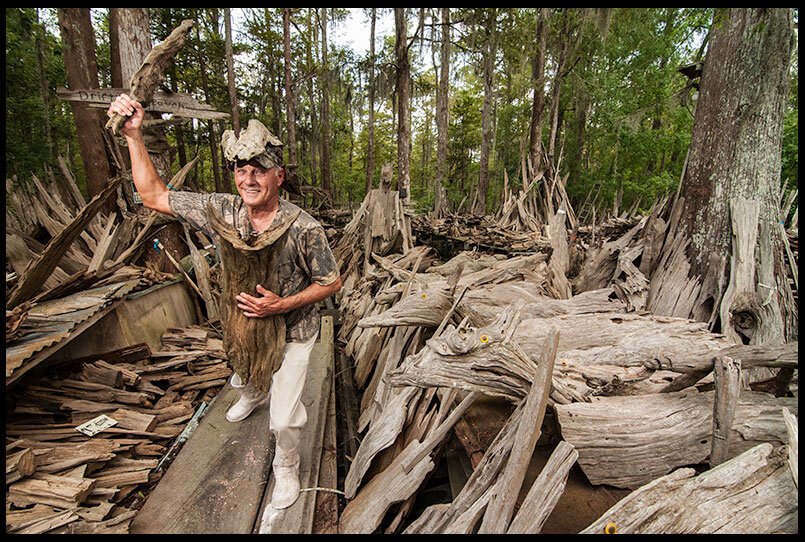
Mr. Adam Morales owned, and operated the Adam's Cypress Swamp Driftwood Family Museum, in Pierre Port, Louisianna. Upon his death I felt moved to write a post about this joyous man, and his driftwood paradise.
There are people you photograph, and then there are people who quietly become part of the way you see the world. Mr. Adam Morales was one of those rare people.
As you read through this article, you may find yourself wondering why I refer to him so formally as Mr. Adam Morales—over and over again. The answer is simple: it is the way I always referred to him. At first—before we became friends—it was out of respect, but then—the more I got to know him, the more I realized that the name was more of a very deserving title—as if addressing royalty. To me, Mr. Adam Morales was royalty - he was Swamp Royalty. He was a breed of Cajun that has all but died out.
I rode with my dear friend, Gene Seneca, on the day that I was to meet Mr. Adam Morales at his home in Pierre Part, Louisiana. His modest home sat at the very edge of the swamp, where the dry ground surrendered to cypress knees and dark water. Scattered around the yard were hundreds of driftwood sculptures—as though the swamp itself had decided to populate the property with its own strange creations.
His home was also home to the Cypress Swamp Driftwood Family Museum, where every sculpture told a story about the swamp and the man who knew it so well.

At first glance, Mr. Adam Morales seemed wonderfully eccentric. That much was obvious from the sculptures that surrounded his home. But beneath that playful spirit was an exceptionally grounded man. That became evident only after spending time on his porch listening to stories of a lifetime spent in the swamps.

Although Adam appeared on Swamp People, and visitors came from around the country—including actress Eva Marie Saint and members of SEAL Team Six—none of it changed him. Fame rested lightly on his shoulders. He remained exactly the man I first met on that front porch beside the swamp.
Mr. Adam Morales was a kid at heart. It was evident in each of our conversations, and it was blatantly apparent in the sculptures he created. In his back yard, which was actually the swamp, he had bins piled high with pieces of driftwood. He called them his "body parts", as the driftwood pieces resembled arms, legs, fingers, etc. - and each were segregated to their own bin. It was from these pieces that he would build his sculptures.
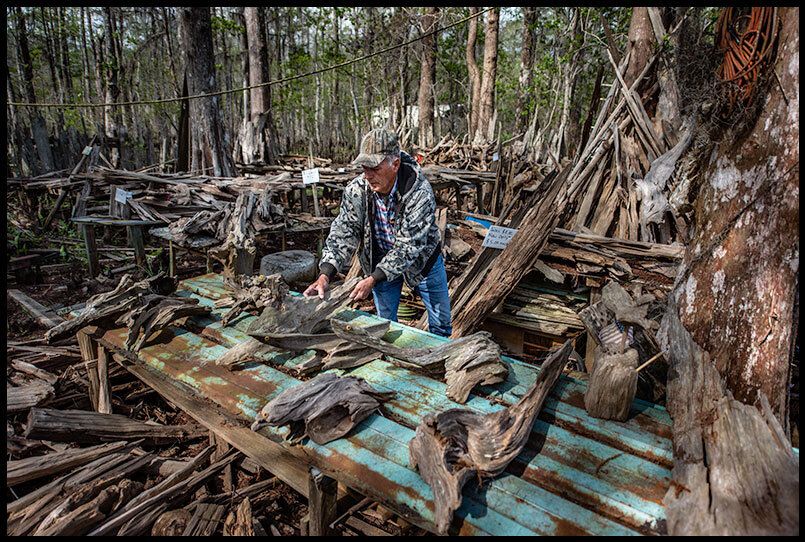
Every time we wandered through his collection of driftwood, Adam would suddenly stop, reach into a pile, and pull out a weathered piece of wood. I would see only an oddly shaped piece of wood. Adam would see a tiger waiting to be discovered. Then, as he turned it in his hands, suddenly I saw the tiger too. He had a way of teaching you to see it too.
In the latter years, Mr. Adam Morales began making oversized lawn chairs out of driftwood. I always wanted to buy a couple, but I never was able to transport them home - they were far too large.

For many years, Mr. Adam Morales made his living harvesting Spanish moss from the swamps. Standing in a small motorized boat, he would use a long pole to pull the moss from the cypress trees before selling it to florists and plant nurseries throughout the region. Then, almost overnight, synthetic moss entered the marketplace, and a way of life that had sustained him for decades simply disappeared.
It was dangerous work. More often than not, venomous snakes were hidden among the moss. When the moss dropped into the boat, the snakes often came with it. Adam never spoke of it as though it were extraordinary. To him, it was simply another day in the swamp.
I am a firm believer that, as we make our way through life - along the path of this great journey, we encounter experiences, and people that, in my way of thinking, become ingredients in the cauldron of soup that is our life's journey. The deeper and more genuine those encounters become, the richer the soup becomes. Mr. Adam Morales became one of the richest ingredients in mine.
Several days ago, word reached me that Mr. Adam Morales had died. With his passing, I couldn't help but feel that a little of old Louisiana had gone with him.

Mr. Adam Morales sitting in his ‘backyard’.
I know that each timeI return to south Louisiana, I will feel the longing to visit with him - and a sadness will become present in my heart. But I am forever grateful to have known Mr. Adam Morales—The King of Driftwood Paradise.
_David
Helen Greyeyes - Part 1:
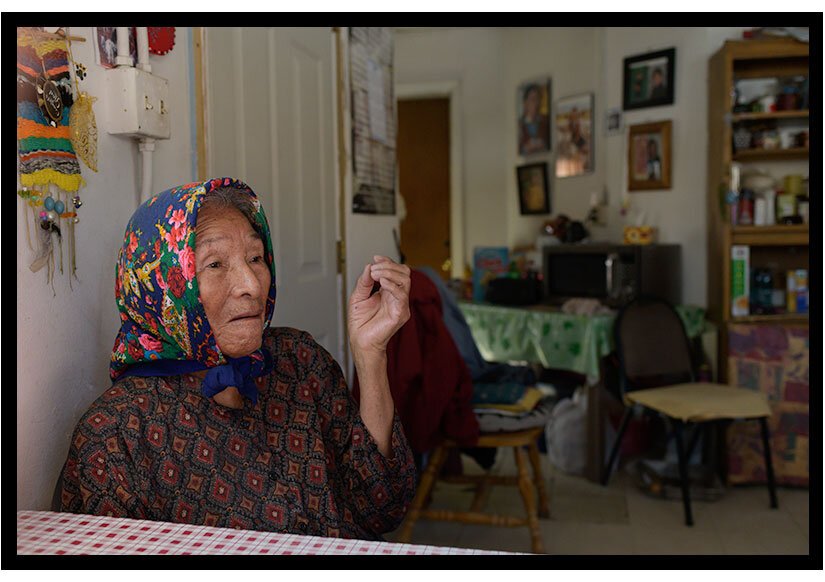
Helen, who is 83 years old, is a traditional Navajo woman. She lives in Blue Gap, Arizona, several miles after the paved road becomes a deep-rutted dirt road. When I visited her, yesterday, that dirt road had become thick with mud - which became challenging even to my Expedition outfitted with Mud tires on the rear. Unfortunately my Expedition is only two-wheel drive. Her younger sister, Alice, was there when I arrived, to translate. Helen only speaks Navajo.

Helen Greyeyes sitting in her chair outside of her Hogon.
Helen Grayeyes is of the Ta’chee'ne clan (on her Mother's side), and the Salt clan (on her Father's side). This is an important distinction in all Native cultures, and is always part of an introduction.
Helen, who is 83 years old, is a traditional Navajo woman. She lives in Blue Gap, Arizona, several miles after the paved road becomes a deep-rutted dirt road. When I visited her, yesterday, that dirt road had become thick with mud - which became challenging even to my Expedition outfitted with Mud tires on the rear. Unfortunately my Expedition is only two-wheel drive. Her younger sister, Alice, was there when I arrived, to translate. Helen only speaks Navajo.
As I walked through the front door, Helen was seated, just to the right of the door's opening. She was wearing traditional clothing, with a colorful scarf over her beautiful gray hair. The features on her face are distinct, as if carved by a master sculptor. Her eyes were of such life, and beauty, that one could not help but to stare, and be soothed.
Helen lives alone. Her days are occupied by herding her sheep, sewing, and weaving traditional rugs on a loom. Alice told me that, each morning, Helen wakes, feeds the dogs, get dressed, then goes for a run along the road, before herding her sheep.

Helen’s sheep returning.
We talked about many things, in general, before getting into specifics. Mostly it was Alice talking - relaying the information that she knows about her sister. She mentioned that there is, at times, a loneliness from living alone, and secluded. But that is not talked about, or even acknowledged to one’s self, in the Navajo culture.
When Alice relayed a question of mine, to Helen, about what it was like growing up traditionally, Helen’s response was, in part, that she regretted not having learned to speak English. She said that, if she had, it would have helped her to better understand the White Man's ways. Helen did not go to school. Instead she remained at home, tending to the sheep, and other domestic chores.
At one point I asked Helen if she was aware of the fact that Man had landed upon the moon. When she answered, yes, I asked what she thought of that. Her response, I found, was quite intriguing - and thought provoking.

Helen Greyeyes’ reaction when asked if she was aware of men landing on the moon.
She said that she disagreed with it - with landing on the moon. Helen said that we should not mess (paraphrasing) with "what is out there”. They should be left alone. The heavens are sacred to the Navajo.
And based upon her response, I made the following statement: Now mankind is attempting to return to the Moon, as well as to Mars - but not as a quest of discovery, but rather, to commercialize both for their assumed mineral wealth.
As the statement was being translated to her, the expression on her face became a very solemn one. After the translation was complete, her voice was still.
End Part 1…
Learning to Wait: Photographing the Navajo on Their Time
“Dine’” which is Navajo for “The People” seemed appropriate for the working title of my newest book project, on the Navajo People. This post talks about a Navajo family to turned to ranching in 1978. But more specifically, they raise bulls for the rodeo. In recent years Freddie has begun turning the business over to his two daughters.
I came to northern Arizona to document the Navajo—their history, their traditions, and their way of life. As with nearly every project I have undertaken involving Indigenous cultures, progress comes slowly. Even when relationships have already been established, trust moves at its own pace. This time is no exception.
I arrived with the expectation that I would begin telling the story of an 83-year-old Navajo woman who still tends her sheep every day and lives much as she has for decades: without electricity or running water. Heat comes from a wood stove, but even the firewood must be gathered from the surrounding hills. It is a life that has largely disappeared elsewhere, yet continues here.
As I neared my destination, however, I received word that her daughter—who would serve as my translator—would not be available. Since the woman speaks only Navajo, her story would have to wait.
Fortunately, another opportunity presented itself. I was invited to photograph a local ranching family and told to arrive at two o'clock the following afternoon. Just before leaving, I received another phone call. The youngest daughter was preparing to load three rodeo bulls for transport.
I arrived just in time to witness the loading. While it wasn't an especially dramatic photographic moment, it was fascinating to observe and, more importantly, it opened the possibility of another story within this growing project.

Then, almost immediately after I arrived, plans changed again.
The horses had escaped from the corral.
Finding them and bringing them home became everyone's priority.
While the search continued across the open plains, I spent time talking with the youngest daughter about her role in the family business, one her father had started in 1976. I also made a handful of photographs as the bulls were loaded into the trailer.
Not long afterward, the horses appeared in the distance.
When I saw Freddie walking across the broad Arizona landscape, leading the horses back toward the corral, I knew I was witnessing the photograph I had been hoping for. I started walking toward him, making photographs as he crossed the open country.

Once the horses were safely returned, it seemed the perfect time to sit down with Freddie for an interview.
It wasn't to be.
Another unexpected complication arose, and our conversation would have to wait. Instead, we stood outside together for several minutes, talking informally beneath the Arizona sky. Freddie spoke about ranching, raising rodeo bulls, and his plans to continue doing so even in partial retirement. Before we parted, we made tentative plans to meet again early next week—if he would be heading out to the ranch where he keeps the bulls.
It means extending my stay by several days.
If it happens, it will be time well spent.
This is their world that I have entered—not my world that they have stepped into. Those are two very different realities. Their priorities are not my schedule. Their rhythms are not my deadlines. Forgetting that would not only be insensitive; it would be arrogant.
Good documentary photography requires patience. Great documentary photography requires humility.
I believe in this story. More importantly, I believe in these people.
The Navajo have a story worth telling—not only for themselves, but for those of us on the outside who have much to learn by listening.
— David
Collusion Between NRA Membership and the Russians:
This post is the result of a piece that I had read, online, that sparked a grave concern - a concern that is not attached to any political affiliation…
September 30, 2019
About a week ago The September 2019 U.S. Senate Committee on Finance Minority Staff Report became public, and made its appearance immediately on social media platforms. Since this had a link to the actual report, I decided to look at it for myself.
In reading the document there are certainly illegalities, but they are the least of my concern, of which there are several. The two [concerns] that top my list are the [seemingly] unprecedented political access that has been granted to the Russian government, over the past several years. As the report states clearly, the high-ranking members of the NRA were granting access to its U.S. political contacts, in return for favors.
This should frighten every U.S. citizen. For decades the United States has gone to war, to prevent the "spread of communism". Yet now Communism seems to be the offering de jour. But it is not "Communism" that we should be afraid of. It is the undermining of our government - and thereby our way of life, by influential powers that we did not elect.
My other concern is that this, like so many other issues that are brought to light, will be used only as a pawn, for political maneuvering by the left, against the right. It will make it appearance on social media (which is has already done), have a short lifespan of soundbites, and blabbering, then disappear into the abyss that is filling with an abundance of sediment of others stories like it.
We scream about the desperate need to close our borders. Yet we are willing to turn a blind eye to a potentially far greater threat. I am reminded of a quote that my mother always reminded me of. It was made by Nikita Krushev, regarding the Soviet Union and the United States. He said (and I am paraphrasing slightly): 'We will bury you from within'
Let us stop the soundbites, and the grade school-level playground bickering, of "he did it, she did it." Instead let us regain control of our government. We can no longer afford to vote on "one issue". We must vote based on what is bets for our country, and our society, overall.
And I want to end this post with a side note, of sorts. This is NOT about the NRA, even though it is their organization that has committed these infractions. Let us not get caught up in in the bullshit of name calling. Instead, let us look at the facts, and address them - in open forums, and public meeting places. Let us bring about a positive change...
https://apps.npr.org/documents/document.html?id=6432520-The-NRA-Russia-How-a-Tax-Exempt-Organization
The Stories We Tell—and the Words We Choose
I have noticed, probably for my entire lifetime - but, for the purpose of this writing, I would say: for quite some time;.[What] I have noticed is an aspect of our collective dialog that hints of a racism.
For as long as I can remember—and certainly for many years—I have noticed something in the way we tell stories.
It is a subtle thing, so subtle that I suspect most people never notice it. In fact, I doubt many who use these words intend anything harmful. The habit has become so deeply woven into our everyday speech that it has become part of the grammar of storytelling.
Yet I also have little doubt that, for some, these same words are rooted in something more deliberate. Whether intentional or not, however, I believe the habit is worth examining.
Yesterday, while attending a large and remarkably diverse gathering, I overheard a conversation that brought this to mind. A middle-aged man was recounting how an acquaintance had been struck by a car while riding his motorcycle. Thankfully, the injuries were minor.
As he told the story—and each time he repeated it—he referred to the driver simply as "this damn Mexican."
The driver's ethnicity had nothing whatsoever to do with the accident.
A few days earlier, someone shared a story about a grocery store employee who had done a poor job bagging groceries. Throughout the story, the employee was described as "this young African American woman."
Again, I found myself wondering why.
Would the accident have been any different had the driver been White, Asian, or Hispanic? Would the poorly packed groceries have been any less frustrating had the employee been a man, or an older woman, or someone whose race was never mentioned at all?
The answer, it seems to me, is no.
So why do we so often include these details?
When race, ethnicity, or gender has no bearing on the story, why does it become part of the description? Why does it seem natural to mention characteristics that contribute nothing to understanding what actually happened?
I do not ask these questions to provoke outrage or to accuse every speaker of harboring prejudice. I suspect many people have never stopped to consider the words they choose because they have heard the same patterns their entire lives. The descriptions emerge almost automatically, passed from one generation to the next until they become invisible.
But perhaps that is precisely why they deserve our attention.
Language does more than communicate facts. It quietly reveals what we notice, what we consider important, and what assumptions we carry without realizing it. Sometimes the smallest, seemingly insignificant phrases tell us more about ourselves than the stories we are trying to tell.
Perhaps these descriptions are harmless habits. Or perhaps they are remnants of old ways of seeing the world that continue to echo through our conversations long after we believe we have moved beyond them.
I don't know.
What I do know is that the question is worth asking—not to shame one another, but to understand ourselves a little better.
This is not merely an American conversation. It is one that belongs to every society, because every culture develops its own shorthand, its own assumptions, and its own blind spots.
Progress rarely begins with certainty.
More often, it begins with someone quietly asking, "Why do we say it that way?"
— David
Nature Has No Agenda
This morning, as I sat in my well-worn leather recliner, with the Calico cat laying across my left arm, and my right had writing thoughts in my journal - all of this part of my morning ritual when I am not on the road, I came to a stopping point. I sat for a few moments longer;
This morning, I sat in my well-worn leather recliner, a calico cat stretched comfortably across my left arm while my right hand filled another page of my journal. It is part of my morning ritual whenever I am not on the road.
Eventually, I came to a stopping point. The pages of my journal remained open, but my pen rested quietly across them. I sat for a few moments longer, looking out the window. The sun had risen, and patches of blue sky had begun to appear through the dense green canopy of the trees.
My first reaction, almost instinctive, was relief. The violent storms and heavy rains that had swept through the night had either moved on or exhausted themselves somewhere beyond the horizon.
Then my thoughts drifted to another morning several years ago.
I had driven to Florida's Gulf Coast to witness Hurricane Michael firsthand—one of the most powerful hurricanes ever to strike the United States. I wanted to see, firsthand, what a hurricane of that magnitude was truly like.
As I watched the storm unfold, I understood why so many who lived in its path described it as violent. The winds were relentless, the rain blinding, and the sheer power of the storm inspired both fear and awe.
Yet the greatest revelation came not during the hurricane itself, but the following morning.
I had spent the night in Fairhope, Alabama, many miles away from where the hurricane made landfall. As I walked the short distance from my hotel room to the breakfast area, I stopped almost involuntarily.
The sky was an impossibly deep blue. A warm, gentle breeze drifted steadily through the air. Everything felt peaceful.
Less than twenty-four hours earlier, I had been sitting in my Ford Expedition fewer than two hundred miles away, witnessing Hurricane Michael's fury. Now the air was calm, the sky inviting, and the world seemed almost untouched.
It was as though nothing had happened.
Later that morning, I drove toward the areas where the storm had passed. Even there, the skies remained brilliantly clear. As I continued west toward Pensacola, I passed dozens of surfers taking advantage of the larger waves the storm had left behind. Once again, beneath cloudless skies, life was already moving forward.
It was then that I realized something I have never forgotten.
Nature has no agenda.
The hurricane was not angry. It was not seeking revenge. It was not punishing anyone or intentionally destroying anything. It was simply responding to changes within the natural world, rebalancing itself according to forces far older than humanity. It just happened that people and their homes lay in its path.
For much of human history, storms, earthquakes, volcanoes, and floods were believed to be the wrath of angry gods. People offered sacrifices in hopes of calming divine tempers and preventing another catastrophe.
Standing in the aftermath of Hurricane Michael, I saw something entirely different.
Nature was not lashing out.
It was simply being nature.
The trees did not resent the wind. The birds did not curse the rain. The shoreline did not seek revenge against the sea. Everything simply adapted and continued.
Perhaps that is where we differ.
We often assign intention where none exists. We interpret hardship as hostility. We search for someone—or something—to blame. But nature offers another perspective. It reminds us that not every destructive force is driven by malice. Sometimes the world is simply responding to circumstances beyond our control.
This morning, as I sat once again in my recliner, the blue sky returned after another night of storms. It looked much the same as it did that morning in Alabama.
And once again, I was reminded that while nature eventually returns to balance, we humans often carry yesterday's storms far longer than we need to.
In Search of Ann Reeves Jarvis: The Woman Who Believed Compassion Could Heal a Divided Nation
On the outskirts of Grafton, West Virginia, at 284 Pearl Felton Lane, sits an unassuming white frame house that has found its place in history as the house of Ann Reeves Jarvis, and the birthplace of Anna Jarvis - the founder, and creator of Mother’s Day. This tiny house is now a museum dedicated to Anna Jarvis, and the entire Jarvis family. But the museum, the house, and the land surrounding it, is steeped in Civil War history, early Civil Rights, the Underground Railroad, and a history of acceptance, and human rights.
February 8, 2019
Most people know Mother’s Day as a celebration of flowers, cards, and family. Few know that its roots began in a small West Virginia farmhouse with a woman who believed compassion should extend beyond battle lines, political divisions, and social boundaries.
On the outskirts of Grafton, West Virginia, at 284 Pearl Felton Lane, sits an unassuming white frame house that quietly holds one of America’s most remarkable stories. This was the home of Ann Reeves Jarvis—the woman whose life and work inspired her daughter, Anna Jarvis, to create Mother’s Day.
Today, the house is a museum dedicated to the Jarvis family. But the story contained within these walls reaches far beyond the creation of a holiday. It is a story of the Civil War, women’s leadership, early public health, the Underground Railroad, and a lifelong commitment to compassion and human dignity.
Ann Reeves Jarvis was an activist long before Mother’s Day existed. In 1858, while pregnant with her sixth child, she created what became known as the Mother’s Day Work Clubs. These grassroots organizations were formed to improve health and sanitary conditions throughout Taylor County, West Virginia, at a time when disease was one of the leading causes of infant mortality.
The clubs provided education and assistance to families, raised money to purchase medicine, and hired women to help expectant mothers experiencing health problems. Their mission was simple: to reduce suffering and improve the lives of those around them.
When the Civil War began, Ann Reeves Jarvis found herself living in a divided nation. Although she lived in Union territory, she refused to take sides in the conflict. Instead, she urged the Mother’s Day Work Clubs to remain neutral and continue serving those in need—regardless of which uniform they wore.
The Jarvis home stood on land that had been part of one of the largest Union encampments in West Virginia during the war. Union officers used the house for strategic planning, yet within those same walls Ann maintained her belief that compassion should not be limited by political allegiance.
When the Methodist Church considered dividing into northern and southern branches, Ann—a deeply committed Methodist—refused to support the separation. She believed faith and humanity should transcend political divisions.
As the war continued, the mission of the Mother’s Day Work Clubs evolved. Under Ann’s leadership, the clubs provided food, clothing, and assistance to soldiers from both sides of the conflict.
Near the end of the war, the Jarvis family moved several miles away to Grafton, West Virginia. There, Ann continued her work within the Methodist Church and oversaw the construction of Andrews Methodist Episcopal Church, where she taught Sunday School and became known as a respected public speaker.
According to the recollections of her daughter, Anna Jarvis, it was during a Sunday School lesson in 1876 that Ann Reeves Jarvis prayed for someone to create a day honoring mothers.
After her mother’s death, Anna carried that vision forward. In May 1907, she organized a private memorial service honoring her mother. A year later, in 1908, she organized the first official observance of Mother’s Day at Andrews Methodist Episcopal Church in Grafton.
After years of advocacy, Anna Jarvis succeeded in having Mother’s Day recognized as a national holiday. In 1914, President Woodrow Wilson signed a congressional resolution declaring the second Sunday in May as Mother’s Day and called upon Americans to honor the day by displaying the American flag.
Today, Andrews Methodist Episcopal Church still stands along Main Street in Grafton. It is now recognized as the official Mother’s Day Shrine.
The Anna Reeves Jarvis House offers another window into this remarkable family’s history. A guided tour begins in the kitchen, where beneath a large rope rug is a small door in the floor. According to the museum’s interpretation, this hidden crawlspace was used during the era of slavery as a place of refuge for those seeking freedom through the Underground Railroad.

A crawl Space, hidden beneath the rope rug that covers a large portion of the kitchen floor, in the Anna Reaves Jarvis house.
Throughout the house, artifacts and documents tell the story of the Jarvis family and the world they inhabited. Relics from the Civil War reveal the challenges faced by families living through one of the most divided periods in American history.

Photographs of Union soldiers occupy a section of tis original desk in the Ann Reeves Jarvis house. Also ration tickets, and a newspaper headline adorn the desk.
But perhaps the most unexpected and moving room is found on the second floor.
There, a collection of dolls fills a small room.
These dolls were not owned by the Jarvis family, but each one carries a story. Over the years, curator Olive Ricketts began receiving dolls from people around the world. Some arrived in person. Others came through the mail with handwritten notes attached.
Many were donated after their original owners had passed away, given to the Jarvis House so they would have a meaningful place to continue their lives.
Each doll represents a mother.
Together, they represent the continuing legacy of Ann Reeves Jarvis and Anna Jarvis—the belief that mothers, families, and human connections deserve to be remembered and honored.
A small piece of paper attached to one quilt acknowledges the person who donated it.
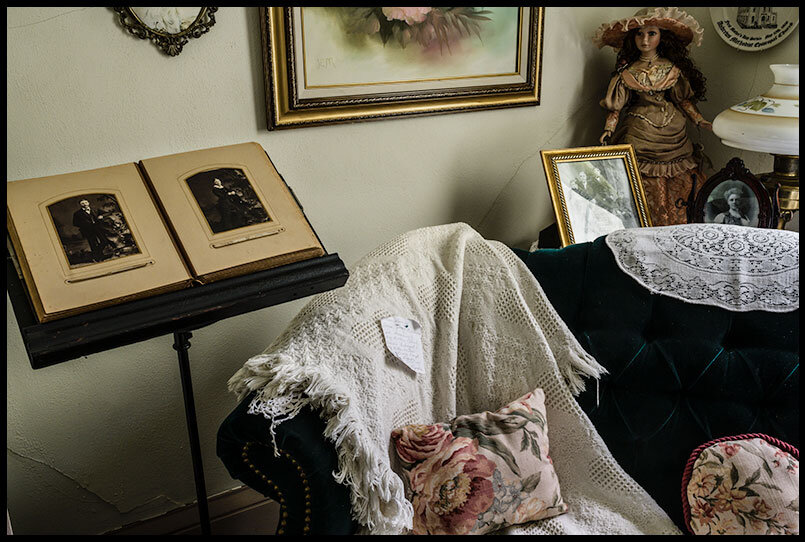
A piece of paper, attached to the quilt, gives an acknowledgement to the person who donated it.
It is a simple gesture, but perhaps that is what makes it so meaningful.
Behind every object is a person.
Behind every person is a story.
And that, ultimately, is the true legacy of Mother’s Day.
The Names We Give Our Hopes
This morning, as I drove from Pittsburgh back to Grafton, West Virginia, I decided to get off the Interstate and explore the town of “Prosperity.” For decades the name has intrigued me - like so many other names of towns across America, with names that make a statement …
August 4, 2019
For decades I have been fascinated by the names of small towns scattered across America—places whose names seem less like locations and more like aspirations.
This morning, as I drove from Pittsburgh back to Grafton, West Virginia, I left the Interstate in search of one of them: Prosperity. Like so many towns across America, its name seemed less a description than a declaration of hope by those who first settled there.
While searching for Prosperity, I first came upon the town of Amity.
Amity—a word meaning friendship, harmony, and goodwill.
Only one road passes through Amity. Two churches face one another across Highway 19—a Methodist church built in 1867 and a Presbyterian church completed seven years later.
Continuing on, I finally arrived in Prosperity—named after “the optimism of its settlers.” The town was much like Amity, although it appeared to be in a somewhat better state of upkeep. Houses lined both sides of the road, some with small front yards. The town sits at the “Y” where Highways 18 and 221 meet.
Having left Prosperity behind, I made a few wrong turns and eventually found myself, as best I can determine, near the town of Good Intent. Seven houses, a Presbyterian church, and a weathered barn stood along West Union Trace. The barn appeared to have witnessed countless seasons come and go.
As though framed within the doorway like a photograph hanging on a wall, a reddish-brown horse stood facing left. It was the only sign of life within the town.

Each time I drove through—which was three times, nearly back to back—there was not a person, dog, or cat in sight. It was as if all life had vanished, or had become quietly sequestered within the walls of the houses scattered across the surrounding hills.
With each of these three towns, I wondered if their namesakes ever became reality.
Perhaps the people who founded these towns understood something we often forget—that communities begin not with certainty, but with hope. Their names were not simply descriptions of what existed; they were declarations of what they believed might one day become possible.
As I continue to reflect on this, I am overcome by a sense of the hope that must have filled these early settlers as they established these places. There was a time when these towns existed only as an idea—when the landscape before them was unsettled, and people were stepping into uncertainty in search of a new beginning.
They were not simply building homes and streets. They were creating a future they could not yet see.