
What Waffle House Taught Me About America
Just after I moved to Nashville, I became aware of the Waffle House restaurants. At first I considered them as a typical “greasy spoon”, but quickly came to realize that they are much more…

Waffle House/Millersville, Tennessee
When I moved to the South more than a decade ago, I discovered Waffle House. At first, it was simply another restaurant that dotted the highways and back roads of the South. As I began traveling those roads more frequently, I found myself stopping at these somewhat iconic restaurants. Initially, I was unimpressed. But over time, I became hooked.
At first, I think it was the predictability that drew me in: the familiar menu, the familiar food, and the familiar atmosphere. Eventually, I realized there was another kind of consistency—the people who ate there and the people who worked there. Waffle House has a culture all its own, a distinctly American subculture, a kind of melting pot.
Every Waffle House has its regulars and its transients. No matter where you are, there are similarities that connect them both. But what has fascinated me most over the years is the culture of the people who work there.
On the surface, there is the language—one I eventually learned to speak myself when ordering: "Pull one sausage. Hash browns, scattered, well done."
Beneath that language, however, is something deeper: craftsmanship, pride, and an unmistakable sense of competition, especially among the cooks. From time to time, I have overheard them comparing how many orders they pushed through during a shift, or talking about the legendary cook at Store #537 who still holds the record. There are bragging rights. The veterans mentor the newcomers, teaching them how to keep pace with the relentless rhythm of the grill while maintaining Waffle House standards. There is pride in the work.
But sometime around midnight, usually between 12:00 and 1:00 a.m., the culture of Waffle House changes.
It is much like the ocean, where one world exists by day and another emerges after dark.
The late-night crowd is made up largely of people coming from clubs, concerts, and bars. Some are customers ending their evening; others are musicians and performers who have just finished a gig. Many are regulars, something made obvious by the easy familiarity between them and the servers who greet them.
The conversations change as well.
During the day, most conversations remain between customers seated at neighboring booths. At night, those invisible boundaries disappear. Patrons and employees become part of the same conversation, voices moving effortlessly back and forth across the counter. The counter still divides the dining room from the grill, but only physically. Socially, it might as well not exist.
I've photographed people in every corner of this country, searching for the places where America reveals itself without performance. Waffle House has become one of those places.
Around these counters, sometime after two in the morning, the labels people carry through the rest of their day seem to lose their importance. Construction workers, musicians, college students, truck drivers, nurses coming off shift, and people with nowhere else to be all find themselves sharing the same space, waiting for the same meal.
It's one of the few places I've encountered where conversation still moves easily across every line we imagine separates us. In a country that often feels divided, that simple fact has become something worth paying attention to.
The King of Driftwood Paradise
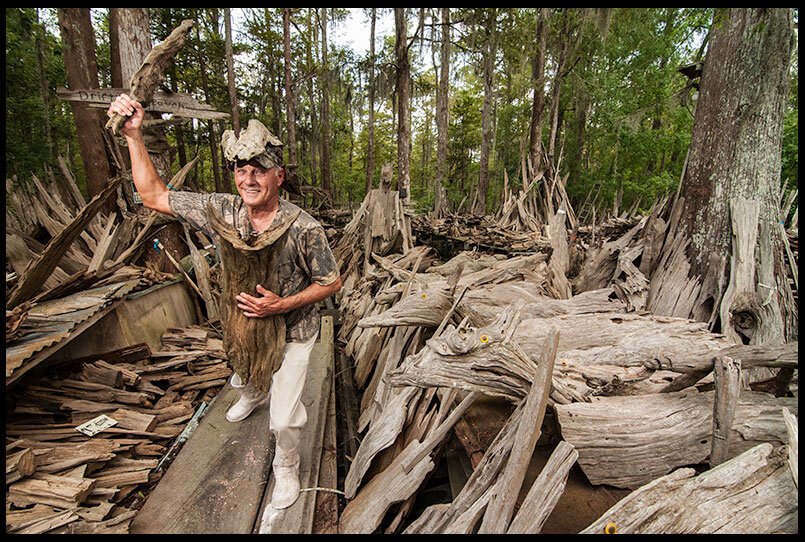
Mr. Adam Morales owned, and operated the Adam's Cypress Swamp Driftwood Family Museum, in Pierre Port, Louisianna. Upon his death I felt moved to write a post about this joyous man, and his driftwood paradise.
There are people you photograph, and then there are people who quietly become part of the way you see the world. Mr. Adam Morales was one of those rare people.
As you read through this article, you may find yourself wondering why I refer to him so formally as Mr. Adam Morales—over and over again. The answer is simple: it is the way I always referred to him. At first—before we became friends—it was out of respect, but then—the more I got to know him, the more I realized that the name was more of a very deserving title—as if addressing royalty. To me, Mr. Adam Morales was royalty - he was Swamp Royalty. He was a breed of Cajun that has all but died out.
I rode with my dear friend, Gene Seneca, on the day that I was to meet Mr. Adam Morales at his home in Pierre Part, Louisiana. His modest home sat at the very edge of the swamp, where the dry ground surrendered to cypress knees and dark water. Scattered around the yard were hundreds of driftwood sculptures—as though the swamp itself had decided to populate the property with its own strange creations.
His home was also home to the Cypress Swamp Driftwood Family Museum, where every sculpture told a story about the swamp and the man who knew it so well.

At first glance, Mr. Adam Morales seemed wonderfully eccentric. That much was obvious from the sculptures that surrounded his home. But beneath that playful spirit was an exceptionally grounded man. That became evident only after spending time on his porch listening to stories of a lifetime spent in the swamps.

Although Adam appeared on Swamp People, and visitors came from around the country—including actress Eva Marie Saint and members of SEAL Team Six—none of it changed him. Fame rested lightly on his shoulders. He remained exactly the man I first met on that front porch beside the swamp.
Mr. Adam Morales was a kid at heart. It was evident in each of our conversations, and it was blatantly apparent in the sculptures he created. In his back yard, which was actually the swamp, he had bins piled high with pieces of driftwood. He called them his "body parts", as the driftwood pieces resembled arms, legs, fingers, etc. - and each were segregated to their own bin. It was from these pieces that he would build his sculptures.
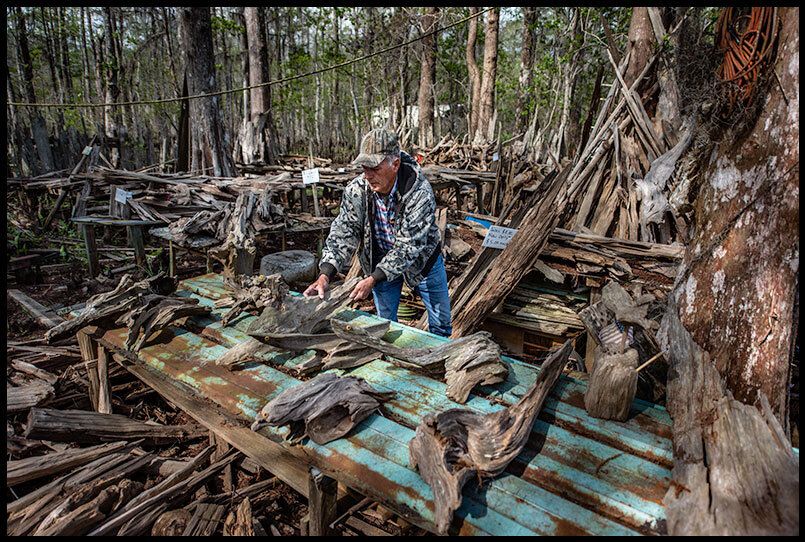
Every time we wandered through his collection of driftwood, Adam would suddenly stop, reach into a pile, and pull out a weathered piece of wood. I would see only an oddly shaped piece of wood. Adam would see a tiger waiting to be discovered. Then, as he turned it in his hands, suddenly I saw the tiger too. He had a way of teaching you to see it too.
In the latter years, Mr. Adam Morales began making oversized lawn chairs out of driftwood. I always wanted to buy a couple, but I never was able to transport them home - they were far too large.

For many years, Mr. Adam Morales made his living harvesting Spanish moss from the swamps. Standing in a small motorized boat, he would use a long pole to pull the moss from the cypress trees before selling it to florists and plant nurseries throughout the region. Then, almost overnight, synthetic moss entered the marketplace, and a way of life that had sustained him for decades simply disappeared.
It was dangerous work. More often than not, venomous snakes were hidden among the moss. When the moss dropped into the boat, the snakes often came with it. Adam never spoke of it as though it were extraordinary. To him, it was simply another day in the swamp.
I am a firm believer that, as we make our way through life - along the path of this great journey, we encounter experiences, and people that, in my way of thinking, become ingredients in the cauldron of soup that is our life's journey. The deeper and more genuine those encounters become, the richer the soup becomes. Mr. Adam Morales became one of the richest ingredients in mine.
Several days ago, word reached me that Mr. Adam Morales had died. With his passing, I couldn't help but feel that a little of old Louisiana had gone with him.

Mr. Adam Morales sitting in his ‘backyard’.
I know that each timeI return to south Louisiana, I will feel the longing to visit with him - and a sadness will become present in my heart. But I am forever grateful to have known Mr. Adam Morales—The King of Driftwood Paradise.
_David